
Highlights:
- White House posts feature distorted videos, pixelated images, and secretive audio hints
- Users speculate an “exciting announcement” could involve Iran or US strategy
- Trump recently postponed strikes on Iranian infrastructure amid denied talks
- Reports indicate potential deployment of 10,000 additional US troops to the Middle East
- Iran warns escalation could trigger broader regional conflict, including Houthi attacks
The White House has sparked global intrigue with a series of cryptic posts teasing an “exciting announcement tomorrow,” sending social media into a frenzy. Shared across official accounts, the content includes glitchy videos, pixelated images, and distorted audio, prompting speculation that President Donald Trump may be preparing a major move on Iran.
The first post appeared late Wednesday on the White House’s official X account. The now-deleted video, which continues to circulate online, shows shaky mobile footage of the ground. A woman’s voice can be heard saying, “It’s so cool. It’s launching soon, right?” An off-camera male voice responds affirmatively.
A subsequent clip features a black screen that reveals a sketch of the White House with the words “President Donald J. Trump” below it. While the audio is heavily distorted, several users who reversed it claim it contains the phrase, “exciting announcement tomorrow.” One video also includes a “shushing face” emoji, hinting at secrecy or anticipation.
Alongside the videos, the White House posted three heavily pixelated images. Two appear to show Trump, while another seems to feature Vice President JD Vance. The posts were mirrored on Instagram, reaching a wider audience and fueling speculation. Within hours, the content had millions of views and countless theories about the nature of the impending announcement.
The timing has drawn attention. US-Iran relations are tense, with the Trump administration deeply involved in the ongoing conflict. While Trump recently postponed planned strikes on Iranian power infrastructure, citing “in-depth, detailed and constructive” discussions with Tehran, Iranian officials have denied any negotiations. Trump has countered these denials, describing Iranian negotiators as “very different and ‘strange’” and claiming they were “begging” for a deal after suffering military setbacks.
Trump issued a stern warning, saying Iran must take the US proposal seriously, emphasizing, “They better get serious soon, before it is too late, because once that happens, there is NO TURNING BACK, and it won’t be pretty!”
Reports suggest that Washington is preparing for multiple scenarios, including deploying up to 10,000 additional troops to the Middle East. These reinforcements would join thousands of paratroopers and Marines already in the region, positioned strategically near Iran, including critical areas such as Kharg Island, a major oil export hub. While Trump has said he does not intend to commit ground troops to combat, the move would offer increased operational flexibility.
Iran has warned that escalation could spark a broader regional response. Tehran has signaled that Houthi rebels in Yemen could target shipping in the Red Sea if the US launches a ground invasion, opening a new front in the conflict and further disrupting global trade routes.
The White House’s cryptic posts may represent a carefully crafted buildup. Whether they hint at a diplomatic breakthrough, a military maneuver, or another strategic initiative is unknown. Analysts and the public alike are now watching closely, waiting to see whether tomorrow’s announcement signals a turning point in US-Iran relations or simply adds another layer to a complex geopolitical chess game.
In a world where messaging, optics, and timing are critical, the White House’s ambiguous teasers have ensured that all eyes are on Washington, with speculation mounting and uncertainty dominating headlines.








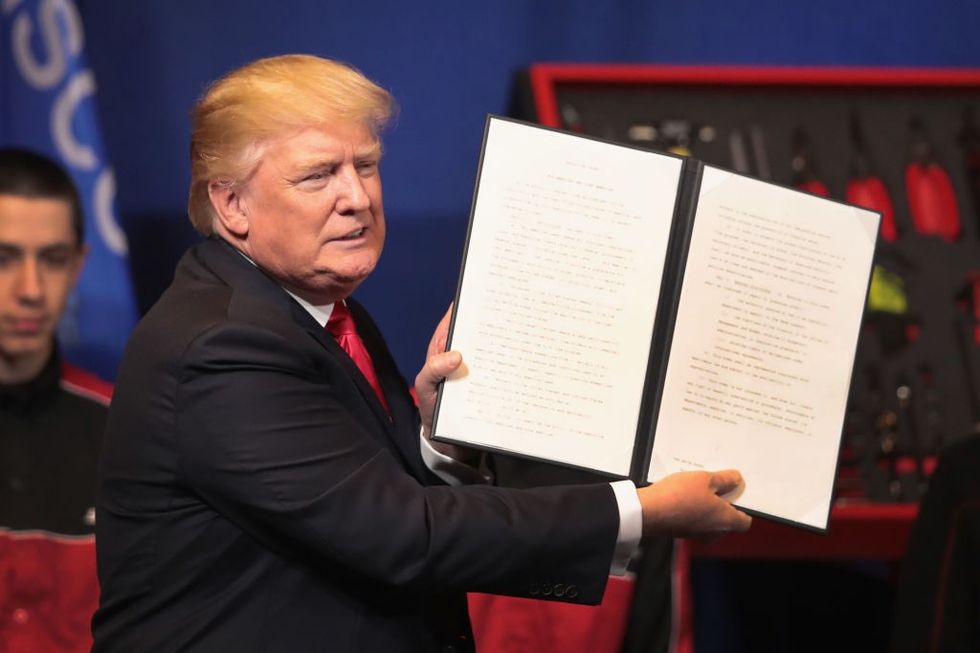 President Donald Trump signs an executive order to try to bring jobs back to American workers and revamp the H-1B visa guest worker program during a visit to the headquarters of tool manufacturer Snap-On on April 18, 2017 in Kenosha, Wisconsin. Getty Images