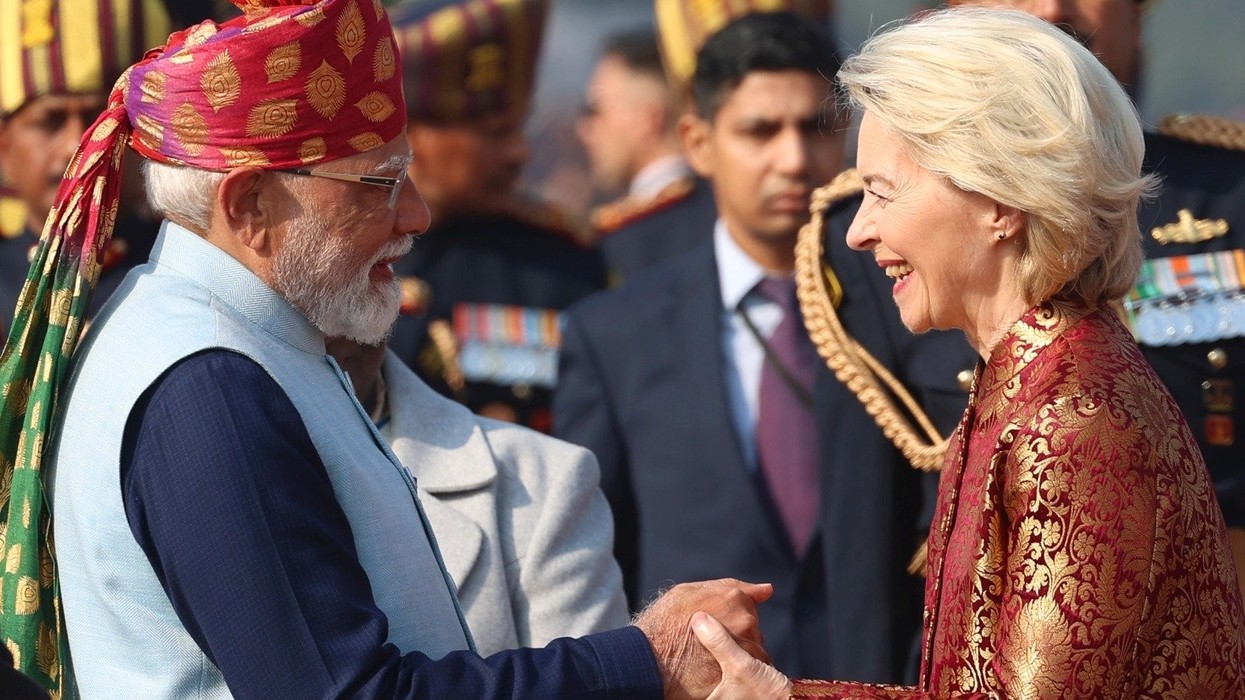

- Ursula von der Leyen attended India’s Republic Day as chief guest
- India and the EU are set to conclude a long-pending free trade agreement
- India may sharply cut tariffs on European car imports
- The EU remains India’s largest trading partner
- The deal comes amid global trade disruptions and US tariff pressures
European Commission President Ursula von der Leyen on Monday emphasized India’s growing importance on the global stage, saying that a “successful India makes the world more stable, prosperous, and secure,” as she attended the 77th Republic Day celebrations in New Delhi. Her visit comes at a pivotal moment, with India and the European Union preparing to finalize a landmark free trade agreement that has been under negotiation for years.
Von der Leyen, accompanied by European Council president Antonio Costa, was the chief guest at the Republic Day parade held at Kartavya Path. President Droupadi Murmu took the salute after arriving in a traditional buggy alongside the two European leaders, escorted by the President’s bodyguards. The high-profile presence underscored the deepening political and economic engagement between India and the EU.
Sharing her thoughts on the social media platform X, von der Leyen described the occasion as deeply meaningful. “It is the honor of a lifetime to be Chief Guests at the Republic Day celebrations,” she wrote. “A successful India makes the world more stable, prosperous and secure. And we all benefit.”
Her remarks came ahead of crucial India–EU summit talks with Prime Minister Narendra Modi. Officials from both sides are expected to announce the conclusion of negotiations on the long-awaited free trade agreement at the summit scheduled for January 27. If finalized, the pact would mark a major milestone in bilateral relations and could significantly reshape economic ties between New Delhi and Brussels.
The European Union is currently India’s largest trading partner, with bilateral goods trade reaching approximately USD 135 billion in the 2023–24 fiscal year. Policymakers believe the proposed free trade agreement could substantially expand trade volumes while also deepening cooperation across sectors such as manufacturing, clean energy, technology, and supply chains.
Beyond trade figures, the agreement is expected to bring a qualitative shift in the overall India–EU relationship, especially at a time when global commerce is being disrupted by protectionist trends and tariff-driven policies from the United States. Growing uncertainty in global trade has pushed both India and the 27-nation EU bloc to strengthen economic cooperation and diversify partnerships.
Negotiations for an India–EU free trade agreement first began in 2007 but were suspended in 2013 due to disagreements over market access and the scope of commitments. Talks were revived nearly a decade later in June 2022, reflecting renewed political will on both sides amid changing global economic realities.
Adding to the momentum, a Reuters report earlier in the day said India is likely to sharply reduce import tariffs on cars from the European Union under the proposed agreement. According to sources familiar with the talks, India may cut duties to 40 percent from the current peak of 110 percent, with further reductions to as low as 10 percent over time.
The initial tariff cuts would apply to a limited number of EU-imported cars priced above roughly Rs 16.3 lakh (about USD 17,700). Such a move would signal a major shift in India’s traditionally protective auto trade policy and could serve as a key concession to unlock the broader trade deal.
Together, von der Leyen’s visit and the anticipated trade agreement highlight a strategic push by India and the European Union to position themselves as reliable partners in an increasingly fragmented global economic order.