
Highlights
- Blue Origin New Glenn rocket explodes during routine engine test
- Massive fireball damages Space Launch Complex 36 at Cape Canaveral
- No injuries reported; all personnel accounted for and safe
- Rocket was tied to Amazon Leo satellite launches and NASA Moon missions
- Explosion raises doubts over timelines for NASA’s lunar plans and Moon base
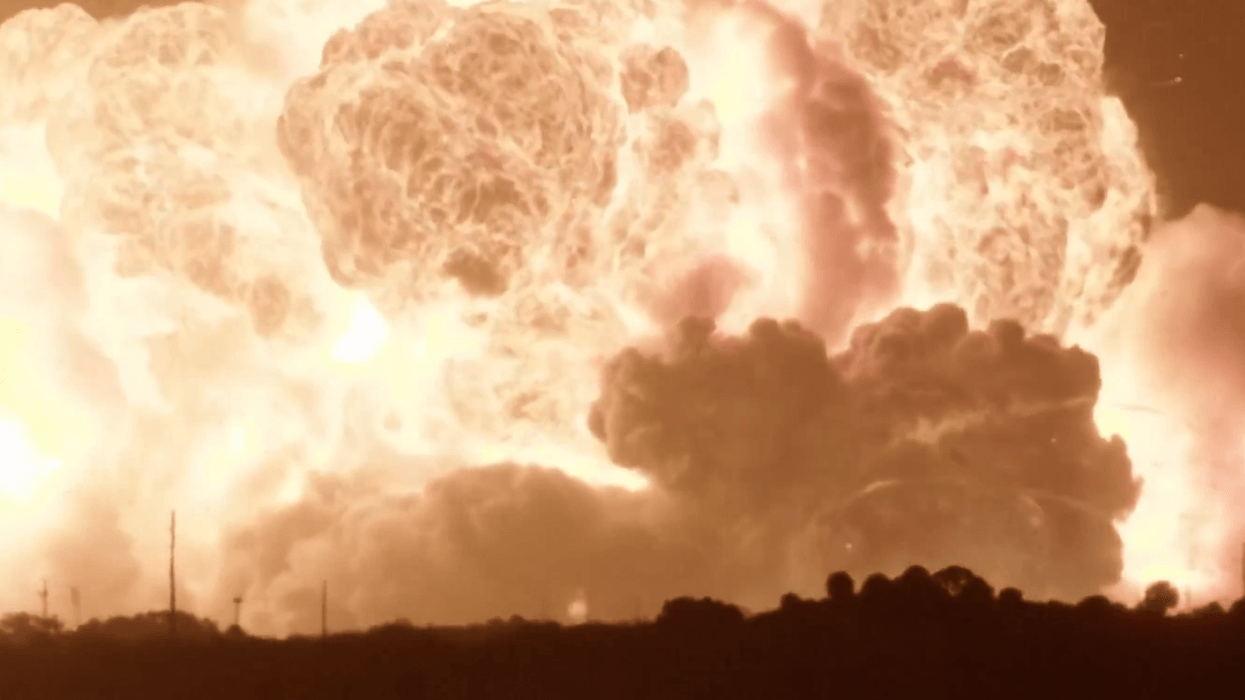
The fireball that lit up the sky over Florida’s Kennedy Space Centre last night has raised questions about whether Jeff Bezos’ Blue Origin can meet its commitments to NASA for future Moon missions and a planned lunar base.
Blue Origin’s New Glenn rocket exploded at about 21:00 local time during a routine engine test.
The 98m (322ft) rocket was scheduled to launch 48 satellites for Amazon’s Leo broadband network as early as 4 June.
The explosion is a major setback for the Leo network, which is trying to compete with Elon Musk’s SpaceX Starlink service. The impact goes beyond this mission.
The good news is that no one was injured.
"All personnel are accounted for and safe," Bezos wrote on X. "Very rough day, but we'll rebuild whatever needs rebuilding and get back to flying. It's worth it."
The blast severely damaged Space Launch Complex 36 (LC-36). Video footage shows a lightning protection tower collapsing after the explosion.
LC-36 is the only site built to launch the New Glenn rocket. Until it is rebuilt and certified again, Blue Origin cannot launch its largest rocket. Analysts say this could take months, not weeks.
The incident comes just days after NASA administrator Jared Isaacman announced the first three missions of a new lunar base programme. He described it as the start of a “permanent presence” at the Moon’s south pole.
The first mission, Moon Base 1, is planned to fly on Blue Origin’s robotic Blue Moon Mark 1 “Endurance” lander. It is targeted for launch no earlier than autumn 2026.
The mission is expected to carry two NASA science payloads to the Shackleton Connecting Ridge. It will also test precision landing techniques for future crewed missions.
However, the lander was planned to ride to the Moon on a New Glenn rocket. The same rocket type is now damaged at LC-36, raising doubts about the schedule.
Earlier this week, NASA also awarded Blue Origin a contract worth up to $468m. The company is to deliver two commercial lunar terrain vehicles built by Astrolab and Lunar Outpost to the Moon’s south pole by 2028.
These rovers are expected to arrive before astronauts land. NASA has set a target of 2028 for a crewed Moon landing, although that timeline was already under question.
The destroyed rocket was also intended to deploy 48 satellites for Amazon’s Leo broadband constellation, formerly known as Project Kuiper. The network aims to compete with Starlink.
More than 300 Amazon Leo satellites are currently in orbit. They were launched using SpaceX, United Launch Alliance, and Arianespace rockets, not Blue Origin.
The gap between Leo and Starlink, which has over 10,000 satellites, is a major commercial challenge for Amazon.
Under its US Federal Communications Commission licence, Amazon must place half of its 3,236-satellite network in orbit by 30 July 2026.
By late May, the company was already more than 1,300 satellites short of the requirement. Delays have been partly blamed on launch vehicle availability.
With New Glenn now grounded for months, Amazon may rely more on rival launch providers, including SpaceX, and may need an extension from regulators.
Elon Musk, SpaceX CEO, responded on X to footage of the blast saying only: "Most unfortunate. Rockets are hard."
NASA administrator Jared Isaacman said on X: "Spaceflight is unforgiving, and developing new heavy-lift launch capability is extraordinarily difficult."
He added that NASA will work with partners to investigate the incident and assess mission impacts.
The setback raises further uncertainty about NASA’s plans for Moon missions and a lunar base, especially timelines already under pressure.