
Highlights:
- Anang Mittal launches Indian American Voter Atlas for 2026 elections
- Platform maps political, economic and demographic data
- Features include interactive maps, district analysis and voter trend tracking
- Highlights 2024 partisan shifts within Indian American voters
- Tracks immigration data, hate crime incidents and policy discourse
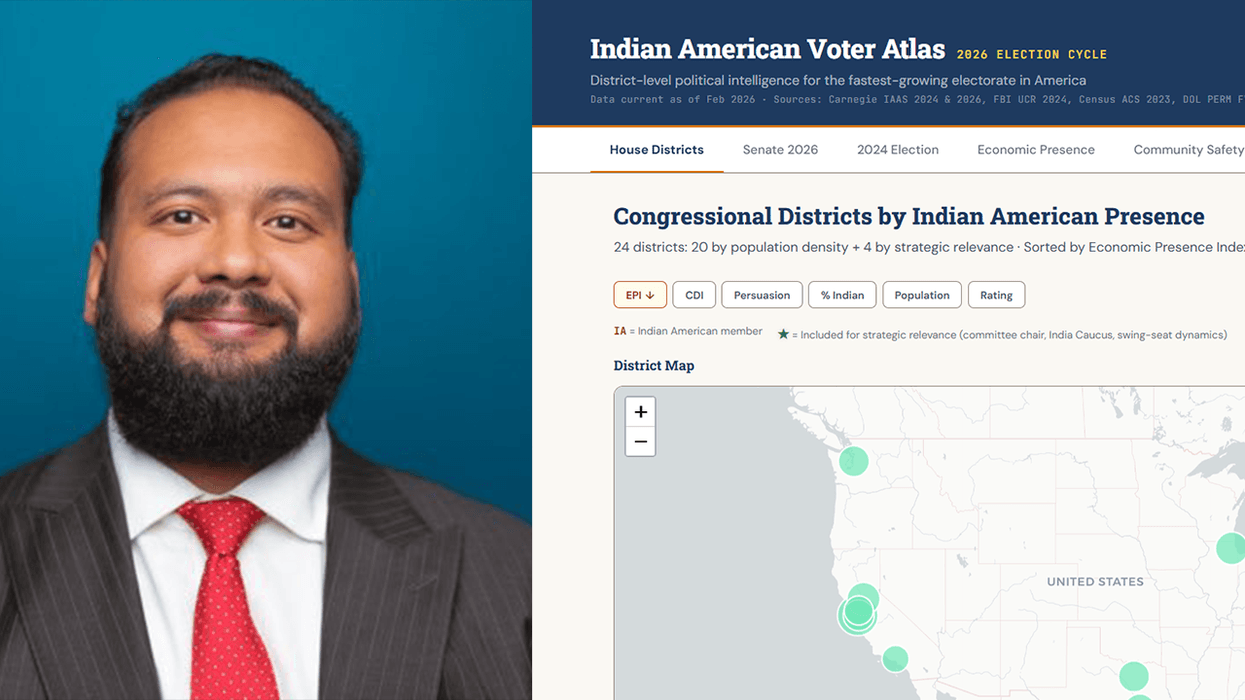
Indian-origin communications strategist and Capitol Hill veteran Anang Mittal has launched a new voter data platform he describes as 'the first nonpartisan, open civic data platform built specifically for and about the Indian American community.'
Promoting the initiative on his official X account, Mittal introduced the website for his civic data project, the Indian American Voter Atlas, created for the 2026 US election cycle. Launched on February 23 ahead of the midterm elections this fall, the platform aims to analyze and map the Indian diaspora’s political footprint in the United States.
What is the Indian American Voter Atlas?
The platform, available at voteratlas.io, offers structured civic data on Indian Americans across the country. Its launch comes as the community emerges as one of the fastest-growing immigrant-origin groups in the US.
Positioned as a public-facing data resource, the initiative seeks to promote more authentic representation while highlighting demographic trends and political participation. Built on a neutral, nonpartisan foundation, the free dashboard compiles data relevant to Indian Americans’ civic presence and tracks how the community’s political engagement has expanded at the city, state and federal levels.
According to a 2026 Carnegie survey, more than 5.2 million people of Indian origin now live in the United States. Even amid renewed “America First” rhetoric under President Donald Trump, Indian American political behavior has drawn attention, particularly after notable shifts in voter support during the 2024 election cycle.
“We’re the highest-income ethnic group in the United States, and we’re concentrated in some of the most competitive congressional districts in the country,” Mittal wrote in a blog post. “In 2024, Indian Americans had one of the most dramatic partisan shifts of any demographic group in American politics.”
Who is the platform designed for?
The Indian American Voter Atlas presents itself as a centralized alternative to scattered census tables, bureaucratic databases, and academic surveys. Its target audience includes:
- Journalists and researchers analyzing Indian American voting trends
- Political candidates seeking to understand the community
- Indian Americans interested in their demographic and civic standing
- Congressional staffers and policymakers reviewing district-level data
- Indian American civic organizations and PACs evaluating where to invest in state legislative races
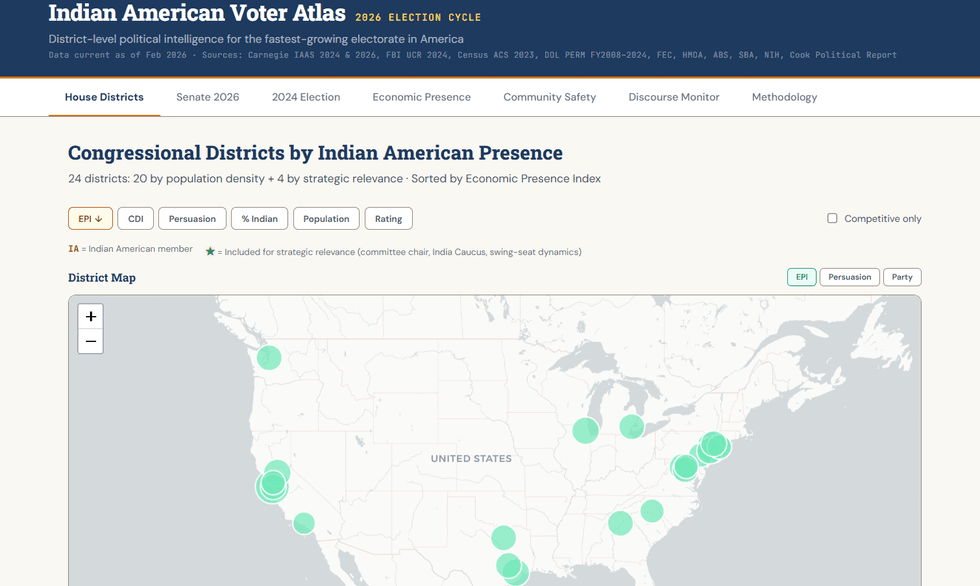 https://www.voteratlas.io/
Key features of the platform
While Mittal has not released detailed methodological documentation, the live, database-backed dashboard includes:
- An interactive national map
- Eight data layers
- Sections such as House Districts, Senate 2026, 2024 Election, Economic Presence, Community Safety, Discourse Monitor and Methodology
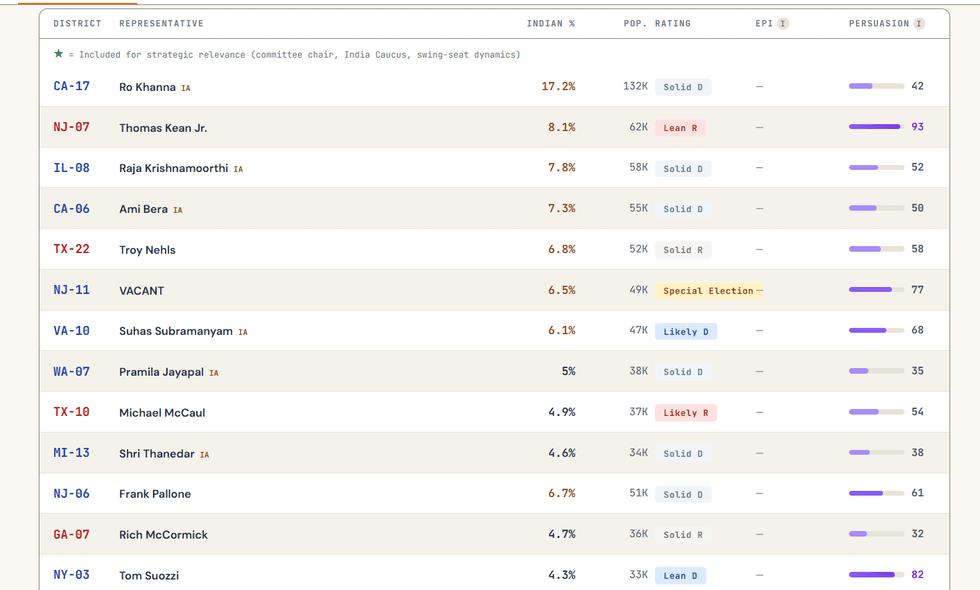
The House Districts section illustrates how Indian American populations align with congressional representation and identifies Indian American members involved in the current cycle.
Each district profile includes the current representative, Cook Political Report competitiveness rating, a proprietary Persuasion Index score, an Economic Presence Index score, and interactive map overlays.
The 2024 Election page characterizes the community as “in political motion,” suggesting Indian American voters may be more policy-responsive than party-loyal.
One example cited: Indian American men under 40 reportedly shifted from supporting Joe Biden by 47 points in 2020 to favoring Trump by 4 points in 2024 — a dramatic swing that mirrors, but exceeds, broader national trends among young men of color.
Community safety and immigration focus
The Community Safety Tracker combines FBI data with community-reported incidents to track anti-Indian, anti-Hindu and anti-Sikh hate crimes. An incident log identifies locations affected by bias-related events.
The Economic Presence section includes subsections on Immigration Pipeline, Household Wealth, Business Ownership, Scientific Research, and Political Economy.
The Immigration Pipeline page details PERM labor certification filings — the first step in the employment-based green card process and lists average wages offered by major employers such as HCL America, Intel and Cisco.
Mittal describes the H-1B visa backlog as “the single most politically consequential issue for a large segment of our community,” noting that many Indian-born workers face decades-long waits for green cards.
 https://www.voteratlas.io/
Reaction to the launch
The launch has drawn praise online.
Washington-based Rohit Sharma called it “a breakthrough moment in U.S. politics,” noting that users can now assess Indian American voter impact at presidential, congressional, state and local levels.
Columnist and podcaster Aadit Kapadia described it as “the one and only comprehensive effort” tracking Indian American voters nationwide.
California attorney Vishal Ganesan labeled it an “awesome resource,” while Renu Mukherjee, a former fellow at the Manhattan Institute, called it an “indispensable resource” for studying Indian American political trends.