
THE Italian branch of a US construction major is being investigated for alleged exploitation of workers recruited from India, court documents showed last week.
Alabama-based Caddell Construction hired Indians to work at the site of a new US consulate in Milan, but put them “on exhausting shifts” and they were “underpaid, without safety protections and under the constant threat of dismissal”, judicial documents seen by Reuters showed last Friday (29).
Caddell Construction specialises in large projects, including contracts for US embassies and military facilities.
The Carabinieri police imposed judicial control on the Italian unit of the US company, the documents showed, in the latest step in a broad crackdown on labour exploitation across several business sectors over the past three years.
Caddell Construction, its Italian unit and the US embassy in Rome did not immediately respond to a request for comment. In a 103-page decree, the firm is accused of recruiting its workforce in India through an intermediary in New Delhi.
Caddell’s Italian unit in 2025 employed a workforce ranging from 311 to 394 people, of whom 316 were from India. In February 2026, the workforce numbered 261.
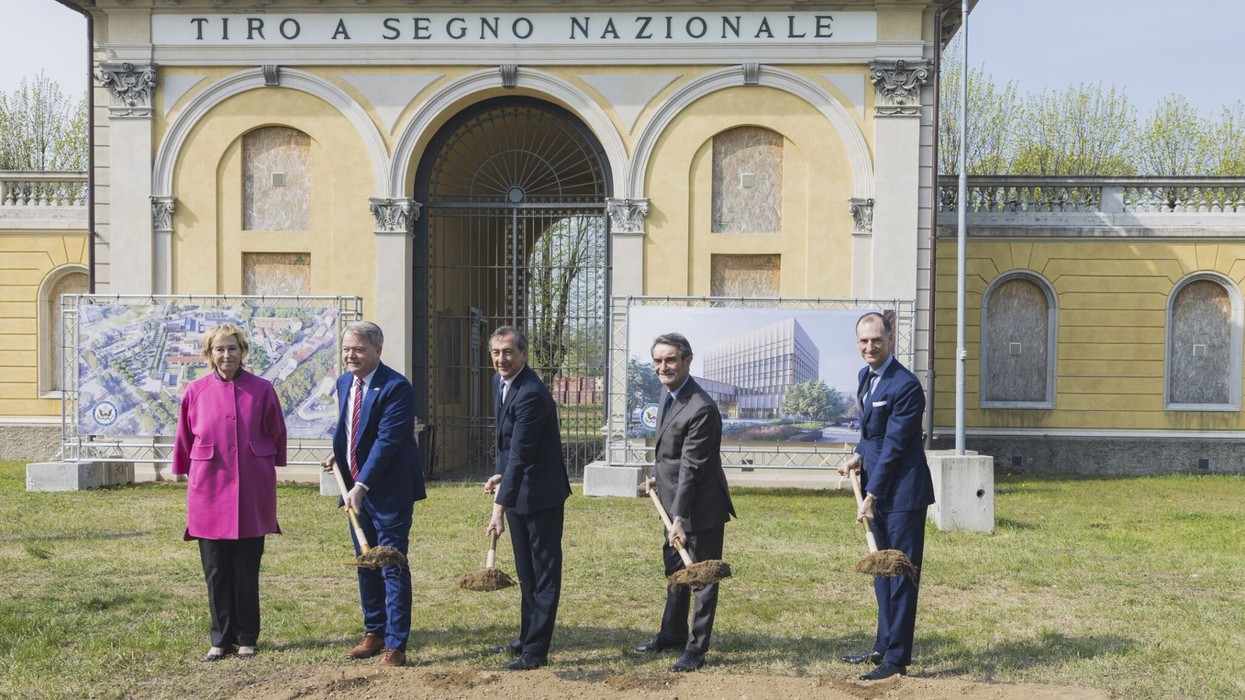
Construction on the US consulate in Milan started in 2022. The contract was worth almost $210 million and work was initially scheduled to finish in 2025, but this date was subsequently put back to 2028.
Judicial control does not halt either the company’s normal operations or work at the construction site. Instead, it imposes a court-appointed administrator tasked with ensuring compliance with labour laws and regularising the existing workers.
The decree must be validated by a judge in the coming weeks.
The document includes statements from 35 Indian workers. All said they had been recruited by an employment agency in New Delhi to be employed by Caddell as labourers in Italy. They all said they had been required to pay `500,000 ($5,225) to receive a 36-month contract and go to Italy.
 An artist’s rendering of the project.
“I had to sell my wife’s gold and ask friends and relatives for a loan, which I will then have to repay,” one of them, named as Gopal Nayak, said in his statement.
In India, the workers were made to sign an employment contract providing hourly pay ranging from €1.31 ($1.53) to €1.91, with food and accommodation paid for by the company. The contract was written in English. All of them said they did not know English, while two said they could not read at all.
The workers said once they arrived in Italy, they signed another employment contract with Caddell’s Italian unit. This contract regularised the procedure for lawful work-related entry into Italy and was fully compliant with Italian labour law, but was never handed over to the workers.
The Carabinieri investigation and witness statements found that the Indians had to work 12 hours a day, six days a week – far exceeding Italy’s legal limit of 40 hours.
Furthermore, while they formally earned between €1,300 and €1,500 a month, mandatory deductions for housing and food, that they had not been warned about, stripped away roughly €800 of their earnings each month. “Every month I sent €300 to India to support my three children, my wife and my brother... I was left with just a bit of money to buy dinner,” said Manoj Kumar, one of the workers questioned.
The judicial decree also said the workers were threatened and mistreated by team leaders, with no sick leave permitted. According to its website, Caddell Construction has a “portfolio including projects worth more than $24 billion throughout the United States and in 38 countries on five continents”.