
- Trump praises India’s election system.
- He highlights India’s strict voter-ID requirements.
- Trump urges Congress to pass the SAVE America Act.
- The bill would require citizenship proof and voter ID.
- Congress remains divided over the legislation.
President Donald Trump is turning to India for an election lesson and his message to Americans is unmistakably clear: if one of the world’s biggest democracies can conduct elections involving hundreds of millions of voters while requiring identification, why can’t the United States do the same?
In a Truth Social post on Monday, Trump praised India’s election process while making another forceful push for the Safeguard American Voter Eligibility, or SAVE America Act, his signature proposal for tighter federal election rules.
"Earlier this month, India's Chief Election Commissioner, Gyanesh Kumar, asked our Administration – How can you have Elections in the US without a valid Photo ID," Trump wrote.
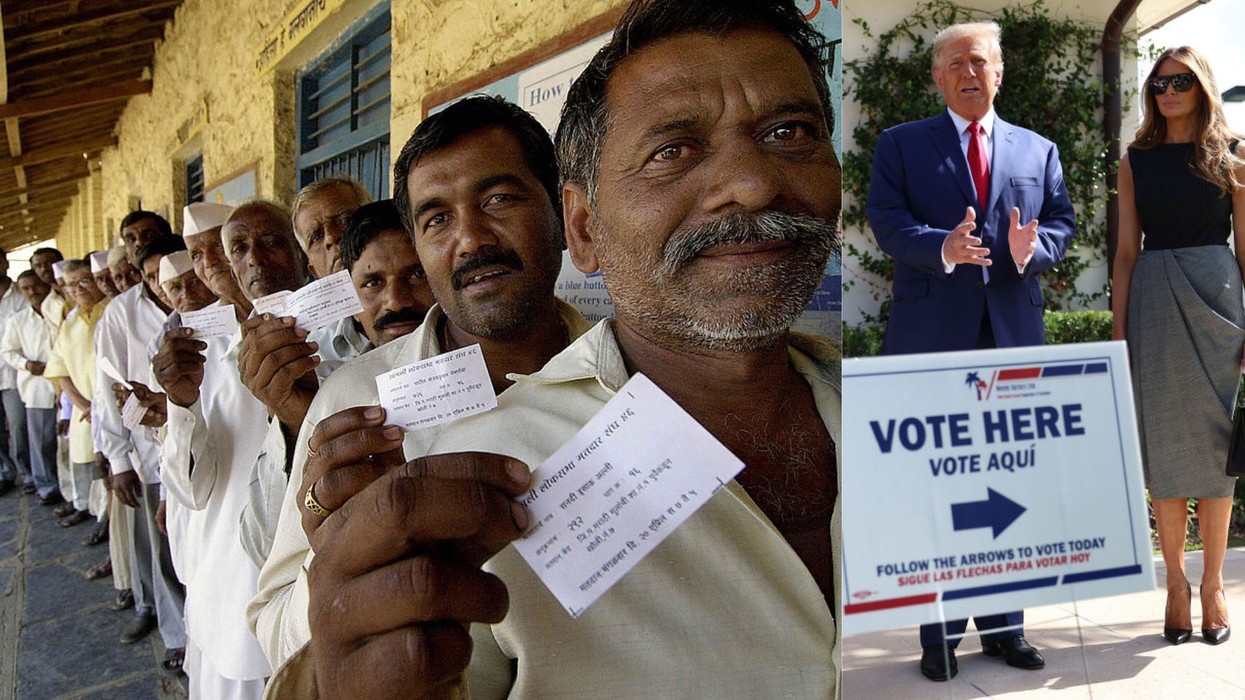
"India's last Election had 646,000,000 Voters! Less than one per cent voted by mail, and every single Voter had to have a VALID Photo Identity Document."
"We need to pass THE SAVE AMERICA ACT, now," he asserted.
“HOW CAN YOU HAVE ELECTIONS IN THE US WITHOUT A VALID PHOTO ID?”
Trump's comparison with India is designed to hit home with Americans who believe election rules should be simple, secure and easy to verify.
India operates one of the world's largest electoral systems, and the scale alone makes its election administration a remarkable logistical undertaking. Trump is using that scale to argue that stronger identification requirements are not an impossible burden — but a basic safeguard.
The White House has similarly highlighted India and Brazil as examples of countries that connect voter identification with biometric databases, contrasting those systems with what it describes as America's reliance on self-attestation for citizenship.
For Trump's supporters, the argument is straightforward: if voters can be identified, why not make identification a nationwide standard?
That message is at the heart of the SAVE America Act.
“WE NEED TO PASS THE SAVE AMERICA ACT, NOW”
Trump has repeatedly urged Congress to approve legislation requiring proof of U.S. citizenship to register for federal elections and voter identification when casting a ballot.
The White House describes the proposal as requiring valid ID, proof of citizenship and significant restrictions on mail-in voting, with exceptions including illness, disability, military service and travel.
The administration has also taken executive action on election verification. In March, Trump ordered the creation of state citizenship lists using federal records and directed officials to strengthen procedures surrounding mail-in and absentee ballots.
The White House says the goal is simple: strengthen confidence that only eligible American citizens participate in federal elections.
Supporters see that as common sense. Critics, however, have argued that stricter documentation requirements could create additional hurdles for eligible voters who lack the required identification or citizenship documents.
TRUMP'S MESSAGE: MAKE AMERICAN ELECTIONS TOUGHER TO CHALLENGE
The political fight is far from over.
The SAVE America Act has become a major dividing line in Washington, with Republicans pushing the measure as an election-security priority while Democrats have raised concerns about access to the ballot and the potential impact of new documentation requirements.
The White House argues that voter ID has broad public support and has repeatedly promoted the legislation as a way to protect election integrity.
Trump, meanwhile, is clearly trying to turn the debate into something much bigger than a technical argument over election administration.
His pitch is essentially this: America should be able to identify its voters, verify citizenship and make elections easier for the public to trust.
And by putting India at the center of that argument, Trump is challenging Americans to look abroad and ask whether the world's largest democracy can enforce strict voter-identification rules at extraordinary scale while the United States continues to fight over whether stronger federal standards are even necessary.
For Trump's supporters, that comparison is energizing.
For opponents, it is another flashpoint in America's already furious election debate.
Either way, Trump's message is unmistakable: he wants the United States to tighten its voting rules and he wants Congress to do it now.