GREEN finance could become a bright and robust strand of the growing India-US economic relations in the next 25 years, India’s envoy in Washington has said, asserting that the two countries have the intent and will to lead the global fight against climate change.
The green economy is diverse globally, but concentrated in a few countries and is bound to find new and emerging markets like India, said Taranjit Singh Sandhu, India’s ambassador to the US.
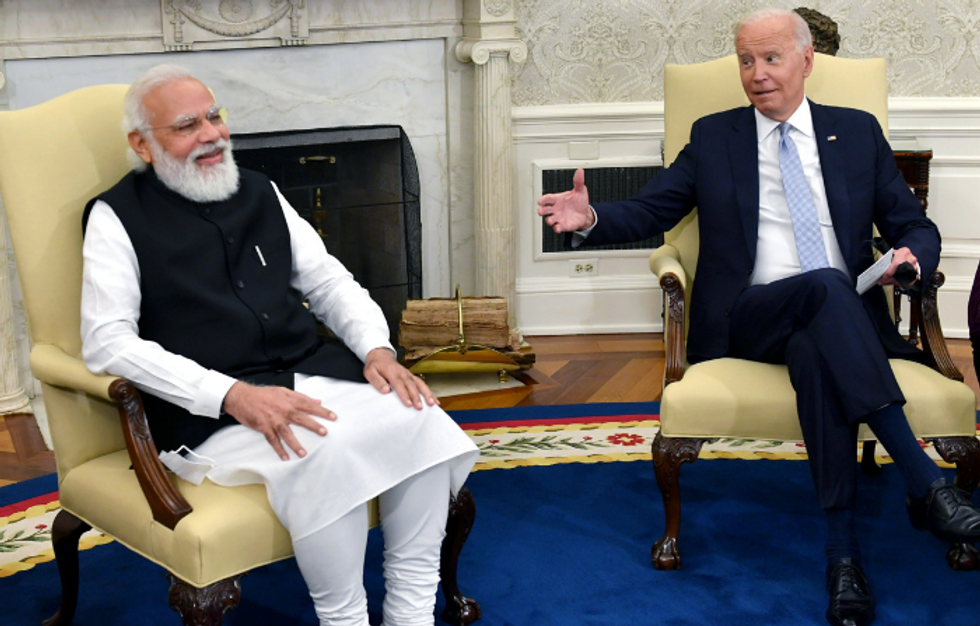 Indian prime minister Narendra Modi with US president Joe Biden at the White House in Washington DC on Friday, September 24, 2021. (ANI Photo)
“This is the very reason, I see, green finance could become a bright and robust strand in the growing US-India economic relations during the next 25 years,” he said on July 19 in his address to a two-day conference on green finance cooperation between India and the United States.
The event was organised by the Indian Embassy in Washington DC in collaboration with the Federation of Indian Chamber of Commerce and Industry (FICCI) and was attended by more than 300 participants from across the globe.
“India and US are natural partners, who have demonstrated time and again, that they can work together, combine their strengths and tap into synergies whenever humanity faces a crisis [COVID-19 pandemic is the most recent example],” he said.
Today, the two countries have strong convergences and our leaderships have the intent and will to lead the global fight against climate change, he added.
This was evident, during COP-26 in Glasgow last year, where Indian prime minister Narendra Modi and US president Joe Biden announced enhanced and ambitious Nationally Determined Contribution (NDC) goals.
“In clean technology, India and US together have the world’s best brains and labs to create cutting edge technologies in green infrastructure,” he added.
In his keynote address, Sandhu quoted Modi, “75 years of Independence should not be restricted to mere celebrations and rather should be seen as the gateway to take on the challenges in the next 25 years.”
In his remarks, Scott Nathan, chief executive officer of the US Development Finance Corporation (USDFC), highlighted that his agency’s commitments in India account for roughly 10 per cent of its active portfolio and marks its largest relationship with any single country.
He added that while the USDFC has already invested $1 billion as climate finance in India, the American development bank looks forward to deepening its engagement with the Indian clean energy sector including in areas like mobility and adaptation.
Other prominent speakers from the United States included Lida Fitts, director of Sustainable Finance, US department of treasury, and Vikram Kumar, global head for transport, Infrastructure and Natural Resources, International Finance Corporation.
India and the United States have an existing robust collaboration in the area of climate finance. Some important and recent examples of partnership in the field include the USDFC’s debt financing for First Solar’s photovoltaic solar module manufacturing facility in Tamil Nadu with a projected annual capacity of 3.3 gigawatts.