

Highlights:
- Best friends’ lives spiral after a shocking relationship twist
- Younger woman starts affair with her mother’s longtime friend
- Show avoids deeper questions about power and consent
- Main romance feels flat and unconvincing
- Side characters deliver more emotional impact than leads
I will be honest. As a committed pessimist, I did not expect “pseudo-incest” drama to be part of my 2026 viewing surprises. Yet Alice and Steve manages to deliver exactly that, and then some. It tries to be bold and messy, but it mostly feels uncomfortable in ways that are not meaningful.
The story centers on Alice and Steve. They have been best friends since university, more than 30 years ago. Alice, played by Nicola Walker, is on her second marriage. Her husband Daniel is younger than her and is calm, kind, and easygoing. They live a stable life with their teenage son and Alice’s adult daughter, Izzy.
Steve, played by Jemaine Clement, is a hairstylist. He has been single since his wife left him four years ago. He feels lonely and lost. After a friend’s funeral, he tells Alice he wishes he had love and a baby. Alice encourages him to find a younger woman who can give him both romance and a family.
Things spiral quickly. Within minutes, Steve is on Alice’s sofa and sleeping with Izzy. Izzy is 26 and recently out of a breakup. She is confident and sure of herself. She even initiates the relationship. She has known Steve since she was a child, which makes the situation feel even more uncomfortable for viewers.
 (L-R) Tom Kingsley, Yali Topol Margalith, Jemaine Clement, Nicola Walker, and Sophie Goodhart attend the "Alice And Steve" Premiere during the 2026 Tribeca Festival at SVA Theater on June 04, 2026 in New York City. Getty Images
The show tries to suggest that Steve is not a predator. Instead, it frames him as weak, lonely, and emotionally confused. But this approach avoids deeper questions. It does not properly explore the power imbalance between an older man and a younger woman who has known him since childhood. Instead of confronting the situation, the story often shrugs and moves on.
Over six half-hour episodes, the show repeatedly tells us that the relationship is intense and passionate. But it rarely shows why we should believe it. The chemistry between the leads feels flat. Steve often looks uncomfortable, and the emotional weight never lands properly. The script tries to sell the romance, but it does not build it in a convincing way.
Alice eventually finds out about the relationship. She reacts with anger and chaos. Her behavior becomes extreme and repetitive. She tries to sabotage the relationship in public and private ways, but her character is written with little depth beyond outrage. Instead of a complex emotional journey, she becomes stuck in the same pattern of reaction.
There are a few side stories that work better. The teenage son Dom has a gentle storyline involving his crush, which feels more natural and human than the main plot. Daniel, Alice’s husband, is also more sympathetic than most of the central characters. His quiet disappointment gives the show its only real emotional grounding.
By the end, the series does not satisfyingly resolve much. It feels scattered and unsure of what it wants to say. The premise promised a sharp exploration of messy relationships and moral discomfort. Instead, it avoids the hardest questions and leaves the audience with frustration rather than insight.
In the end, the “ick factor” is not even the biggest problem. The bigger issue is that the story never fully commits to its own ideas.














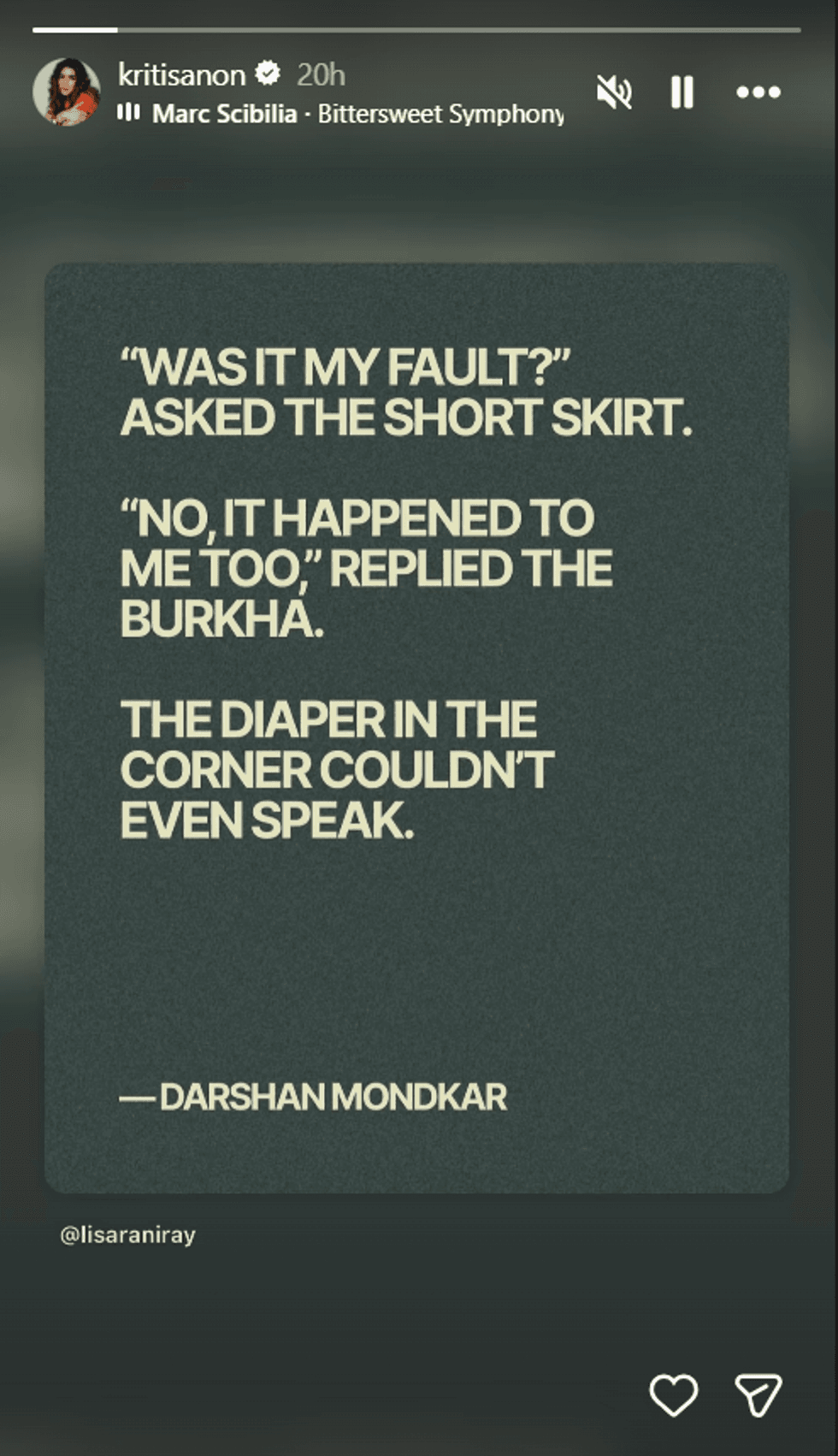 A screenshot of Kriti Sanon's Instagram story.Instagram/@kritisanon