
Highlights:
Indian-American student Anika Puri was shocked to see jewelry and statues sold in Mumbai markets as ivory. The sight raised a question that would eventually lead her to develop an artificial intelligence tool to help wildlife rangers detect potential poachers.
"I had always assumed that well, poaching is illegal, how come it is still such a big issue?" Puri told Smithsonian Magazine, recalling her reaction.
Her family had visited India regularly while she was growing up, but the 2018 trip left a lasting impression. India had prohibited domestic ivory sales in 1986 and banned imports of African ivory in 1991. The international commercial ivory trade had also been banned in 1989 under the Convention on International Trade in Endangered Species of Wild Fauna and Flora (CITES).
Puri could not independently establish whether the items she saw in Mumbai were genuine ivory. But the experience prompted her to investigate why poaching continued despite legal restrictions.
Her research revealed the scale of the problem. Africa's forest elephant population had declined by 62% between 2002 and 2011. She also learned how wildlife rangers used drones to monitor protected areas and gather footage that could help them identify poachers.
That led her to notice something that became central to her invention: humans and elephants move differently.
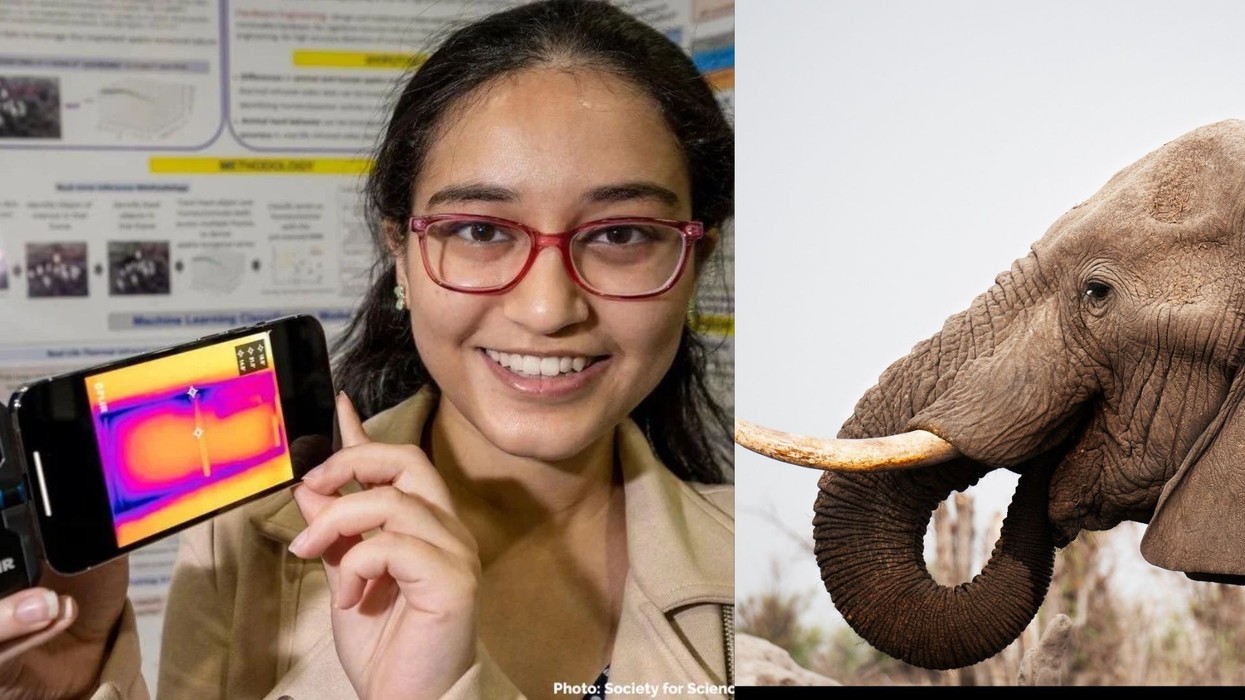
At 17, Puri developed ElSa, short for Elephant-Savior, an AI-based system that analyzes movement in thermal infrared drone footage to distinguish humans from animals. Her work earned her recognition as a 2022 Davidson Fellow and a $25,000 scholarship.
How ElSa uses AI to spot potential poachers
Wildlife rangers monitoring protected areas at night face a difficult task. Thermal cameras can capture movement in darkness, but humans and animals may appear similar in footage recorded from drones flying hundreds of feet above the ground. Reviewing hours of recordings manually can also be tiring and time-consuming.
Puri designed ElSa to help address that challenge. The system analyzes movement patterns, speed, turning radius and herd behavior to distinguish humans from animals in thermal infrared videos.
Tested on the BIRDSAI dataset, which contains footage from four African national parks, ElSa achieved 90.9% accuracy in detecting humans. According to findings cited in her research, this was approximately four times the accuracy of the existing methods used for comparison.
The system does not automatically identify someone as a poacher. Instead, it could flag human activity for rangers to investigate further, helping them focus their attention on footage that may require closer examination.
Why she built a $300 prototype
Puri also focused on making the technology affordable. High-resolution thermal cameras can cost around $4,800, while she developed her ElSa prototype using commercially available components for approximately $300.
The lower development cost could make automated monitoring more accessible to conservation teams with limited budgets. However, the prototype's price is not the total cost of deploying a complete operational system, and its effectiveness in real-world conditions requires further evaluation.
ElSa was developed and tested for African wildlife parks. Puri's experience in India inspired the project, but the tool's testing was conducted using footage from African parks.
The conservation problem behind her innovation
India's ivory laws reflect a long effort to protect elephants. The country amended the Wild Life (Protection) Act in 1986 to prohibit domestic ivory sales and banned imports of African ivory in 1991. The Supreme Court later upheld the import ban.
Yet the presence of items sold as ivory in markets has continued to raise concerns about the illegal trade and the circulation of older carvings. Their appearance alone, however, does not establish whether a particular item is genuine or illegally traded.
For Puri, the Mumbai experience became the starting point for a wider investigation into wildlife crime. Her work shows how an observation made during a family visit can develop into a technical solution to a problem far beyond the place where the idea began.
By combining machine learning with drone surveillance, ElSa offers a potential way to help rangers identify human movement more efficiently. Further testing will determine how well the technology performs in the field, but its underlying idea began with a simple question from a teenager who wanted to understand why an illegal trade could still threaten wildlife.