
For the first time, a major power has said out loud what analysts had long suspected: the United States has weapons stationed in space. Speaking at a defense conference in Maryland on Monday (14), US Air Force secretary Troy Meink confirmed that American forces now have on-orbit systems built to counter hostile action against US satellites, and signaled Washington's willingness to respond to threats threats “wherever they exist”.
“The United States now has on-orbit space control weapons capable of defending the joint force against hostile adversary action,” he said.
It's a rare moment of official transparency on a subject that governments have preferred to leave vague. And it has landed at a tense time, reigniting a debate over whether the contest for control of space is drifting toward actual conflict, and what that would mean for a world, including India, that now runs on satellite infrastructure.
What kinds of weapons are actually used in space?
The image most people have - a missile blowing up a satellite - is probably the least likely scenario going forward. That kind of strike scatters thousands of pieces of debris that no one can steer around, including the attacker's own hardware.
Sir Chris Deverell, a former British four-star general who led the UK military's space operations and now advises space and defense startups, told The Times that "satellites have already been knocked out by ground-based weapons from India, China, Russia and the US" - evidence, he said, that rival powers have already shown each other their hand.
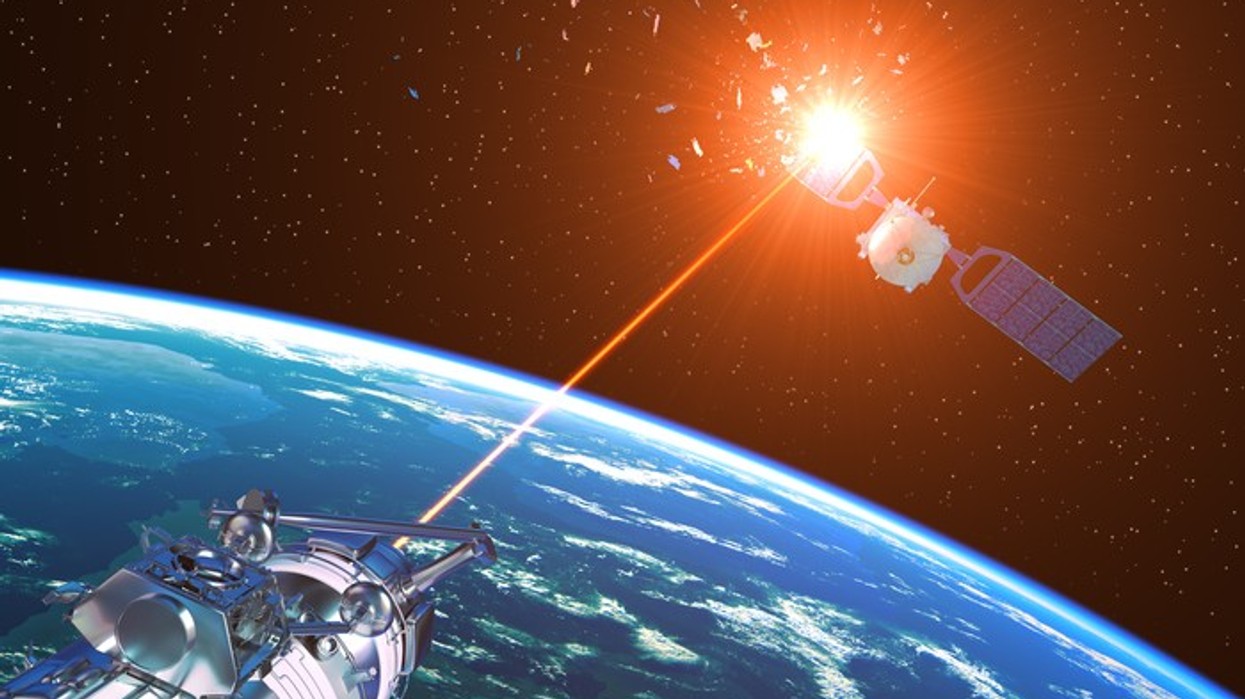
What's more likely going forward is quieter: jamming tools that override an adversary's communications, "laser dazzlers" that can blind a satellite's sensors without destroying it, and rendezvous-and-proximity operations, where one satellite maneuvers alongside another and nudges it out of position.
Deverell pointed to GPS as the likeliest early target in any real confrontation, warning that knocking out navigation satellites would disrupt not just military operations but banking and telecommunications systems that depend on them.
What do China and Russia think of space conflicts?
Beijing's response was swift and pointed. China's foreign ministry accused Washington of pursuing "the weaponisation of outer space, turning it into a battlefield", according to a spokesperson's remarks reported by AFP, and called on the US to stop preparing for war beyond the atmosphere.
Russia's position was less combative but pointed in the same direction: a Kremlin spokesperson said Moscow wants to see international consensus build toward fully demilitarizing space, rather than a race to arm it further.
Neither reaction was really surprise — one military analyst described the US disclosure as an open secret finally spoken aloud, not new information. The bigger concern raised by space law experts is regulatory: the 1967 Outer Space Treaty bans nuclear weapons and weapons of mass destruction in orbit, but says nothing about jamming, lasers or satellite-nudging, leaving most of what's actually happening in orbit unaddressed by international law. That gap is expected to surface at the UN's disarmament talks in November.
Where does India's capabilities stand?
India's own entry into this contest predates the current moment by years. On March 27, 2019, prime minister Narendra Modi interrupted the country's news cycle to announce that an Indian interceptor had destroyed a live Indian satellite roughly 300 kilometers above Earth, declaring that "India has today established itself as a global space power" — a test, called Mission Shakti, that made India the fourth country after the US, Russia and China to demonstrate the ability.
India hasn't repeated a live intercept test since, but its military-space program hasn't stood still. The Defence Space Agency ran the country's first dedicated space-war exercise, Antariksha Abhyas, in late 2024, war-gaming threats to Indian satellites and their role in military operations. India has also expanded its military communications, reconnaissance and electronic-intelligence satellites, along with its own space-surveillance network, and defense research documents point to continued work on directed-energy weapons and space-based lasers.
What India has not done, at least publicly, is place an offensive weapon in orbit the way the US now says it has. That's a meaningful distinction: a ground-launched anti-satellite missile is a one-time, visible demonstration, while an orbital weapon is a standing, ready-to-use capability. For now, India remains a country that has proven it can strike from the ground, in a world where the leading space powers are shifting the contest into orbit itself.
So what happens next?
None of this makes a war in space inevitable. But it does mean satellites - the infrastructure behind GPS, banking, phone networks and India's own defense communications - are now openly treated by at least one major power as legitimate military targets. With no treaty covering non-nuclear space weapons and a UN debate approaching in November, the next few months should show whether nations start negotiating real rules for space, or simply stop pretending they need them.