

Highlights:
The latest teaser of Yash’s upcoming film Toxic: A Fairy Tale for Grown-Ups has triggered a heated debate across social media, with audiences split on whether the film reflects misogyny in its creative framing or is instead a carefully engineered ragebait campaign designed to dominate online conversations.
Directed by Geetu Mohandas, the film stars Yash alongside a prominent ensemble cast including Nayanthara, Kiara Advani, Huma Qureshi, Tara Sutaria, and Rukmini Vasanth. The project has already attracted attention for its scale and tone, but the newest promotional drop has intensified scrutiny over how its female characters are being presented.
Titled “Ladies & Ladies,” the 1-minute-40-second teaser was promoted as an introduction to the film’s female cast. However, instead of spotlighting the ensemble equally, viewers quickly noticed that Yash remains the dominant presence throughout, appearing repeatedly in voiceover and visual focus, while the female actors are given only brief, fragmented appearances.
Nayanthara is seen riding a bike, Kiara Advani appears in a stylized dance moment, Huma Qureshi is shown in action-heavy frames, and Tara Sutaria and Rukmini Vasanth appear in brief glimpses tied to the narrative’s tension. Despite this, the teaser maintains a strong narrative and visual focus on Yash.
This imbalance has sparked questions online about whether the teaser fulfills its promise of introducing the “ladies” of the film or whether it simply uses that framing as a hook while keeping the star hero at the center.
Misogyny or marketing strategy?
The reaction to Toxic has now moved beyond surface-level criticism and into a broader discussion about intent.
Some viewers argue that the teaser reflects a familiar pattern in mainstream commercial cinema, where female characters are visually present but narratively secondary. The concern is not only about screen time but also about framing—who drives the story, and whose perspective defines the tone.
Others, however, believe the backlash itself may be part of the film’s design.
In the current digital entertainment ecosystem, controversy often translates directly into visibility. Every debate, reaction video, and social media argument increases reach and keeps the project trending. From this perspective, Toxic appears less like a traditional promotional rollout and more like a carefully structured attention strategy.
A teaser built for reaction culture
What makes Toxic stand out is not just its content but the pattern of its promotions. Each release so far has generated strong online responses, with audiences dissecting tone, visuals, and thematic choices.
The latest teaser continues that trend. Instead of offering clarity about the female characters, it has raised more questions—about narrative intent, gender representation, and the role of the star in shaping the film’s identity.
This has led some industry observers to suggest that the film may be operating within a “reaction-first” marketing model, where the goal is not immediate narrative coherence but sustained digital conversation.
In such a model, outrage and praise are equally valuable, as both drive engagement and visibility.
Star power and ensemble imbalance
Another key point of discussion is the dominance of Yash across the promotional material. Despite the presence of several major female stars, the teaser remains heavily centered on him, both visually and narratively.
This has reignited a familiar conversation in commercial cinema about how star power often overrides ensemble storytelling in marketing campaigns. Even when multiple leads are announced, promotional focus tends to gravitate toward the most commercially dominant figure.
In Toxic, this dynamic becomes especially visible because the teaser’s framing suggests an ensemble spotlight that the execution does not fully deliver.
As Toxic moves closer to release, it continues to sit at the center of a growing debate: is it reinforcing problematic cinematic patterns around gender representation, or is it intentionally designed to provoke exactly this kind of reaction?
What is clear is that the conversation itself has become part of the film’s promotional cycle. Whether intentional or not, Toxic is generating sustained attention across platforms.
And in today’s entertainment landscape, that attention may be the most powerful marketing tool of all.





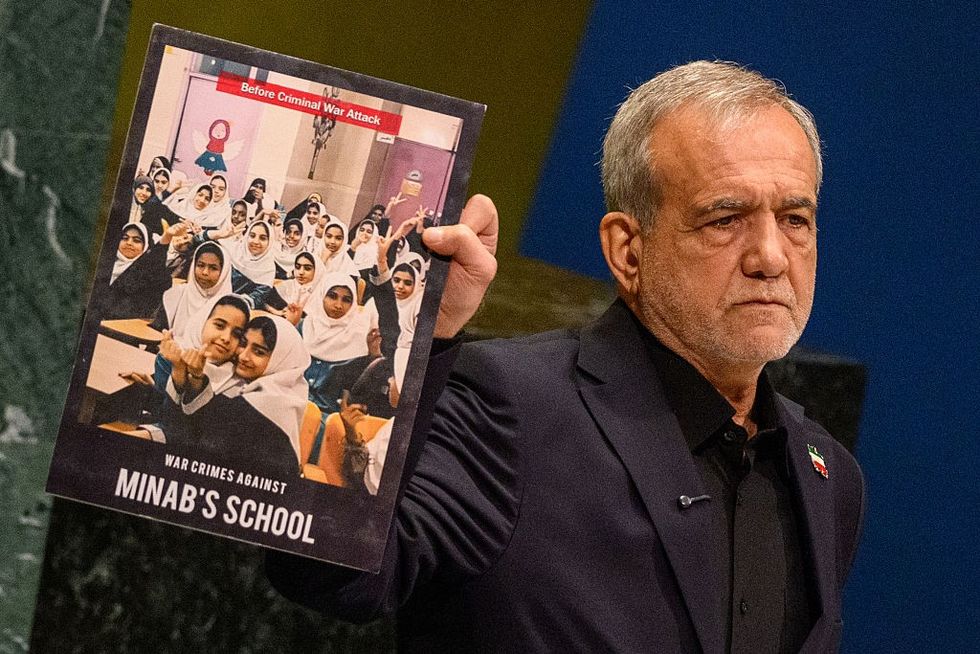 President of Iran Masoud Pezeshkian holds up a poster of a girl's school that was attacked while addressing the 81st session of the United Nations (U.N.) General Assembly at U.N. Headquarters on September 23, 2026 in New York City. World leaders have gathered in New York for the annual session of the United Nations General Assembly, with this year's global issues ranging from the threat of artificial intelligence to the continued wars in Ukraine and Gaza. Getty Images