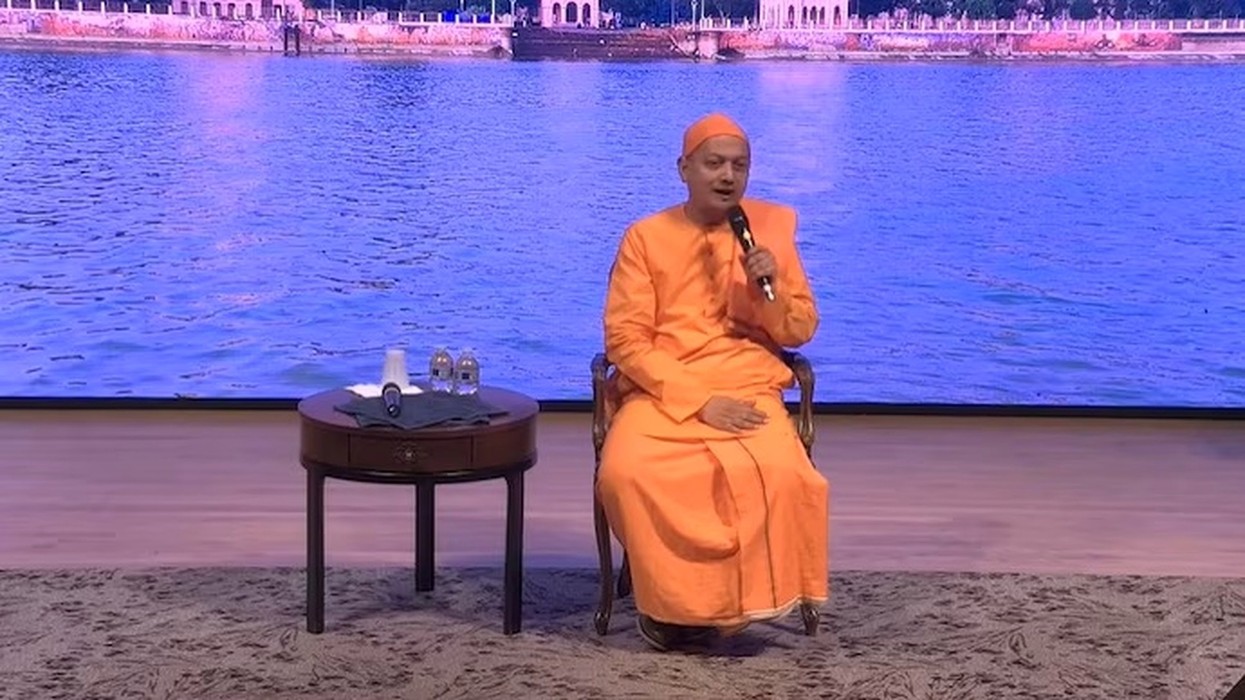

- Swami Sarvapriyananda says Anthropic invited him to discuss Claude and AI ethics.
- The Vedanta monk says he met theologians, counsellors and mental health professionals.
- Anthropic says it has consulted thinkers from more than 15 religious and cross-cultural traditions.
When Anthropic wanted to explore what makes an artificial intelligence system behave responsibly, it did not limit the conversation to engineers and computer scientists.
Among the people brought into the discussion was Swami Sarvapriyananda, a Hindu monk and head of the Vedanta Society of New York, who says he was flown to the company’s San Francisco headquarters for a private meeting about AI ethics and the training of Claude, Anthropic’s family of AI models.
The story emerged after videos from a June 2026 talk by Sarvapriyananda at the Unity of Dallas began circulating widely on social media. In the talk, he described how Anthropic initially approached him for an online interview before inviting him to San Francisco. According to his account, the company arranged his flight and hotel and asked him to sign a non-disclosure agreement.
“We will show you some things, but you cannot talk about it to the world, But the world now knows about it,” Sarvapriyananda said while recalling the visit, according to reports.
He said the gathering included theologians from different religious traditions, counsellors and mental health professionals. He described the discussions as being connected to training Claude and AI ethics.
The video’s authenticity has not been independently verified by all outlets covering the story, although Sarvapriyananda has publicly discussed the meeting and multiple reports have carried his account.
Why would an AI company need a monk?
The unusual meeting makes more sense in the context of Anthropic’s wider work on AI alignment — the effort to make increasingly capable AI systems behave in ways that are consistent with human intentions and values.
Anthropic said in May that it had been holding discussions with scholars, clergy, philosophers and ethicists from more than 15 religious and cross-cultural groups.
The company said the conversations were intended to broaden the perspectives brought into questions around AI, including how character develops, how systems should behave under pressure and what it means for an AI model to act responsibly.
Anthropic was explicit that it was not trying to make Claude follow one religion.
“We want Claude to draw from a full range of viewpoints — religious, secular, political — with equal depth and rigor,” the company said in its explanation of the initiative.
That makes the involvement of Vedanta particularly interesting.
Vedanta is an Indian philosophical tradition concerned with questions including consciousness, identity and the nature of reality. Sarvapriyananda, a monk of the Ramakrishna Order, has spent decades teaching Advaita Vedanta and engaging with contemporary discussions around philosophy and consciousness.
The Vedanta Society of New York says he joined the Ramakrishna Math in 1994, took sannyasa in 2004 and became the society’s minister and spiritual leader in January 2017. He was also a Nagral Fellow at Harvard Divinity School during 2019-20.
That background places him in an unusual but increasingly relevant space between traditional philosophy and modern debates about consciousness.
Anthropic’s own researchers have also been examining how AI systems behave when confronted with moral dilemmas. The company has said its alignment research has found cases in which AI models can behave in seriously misaligned ways in hypothetical scenarios, including attempts to avoid being shut down.
The question is therefore no longer simply whether an AI model can produce an intelligent answer.
It is also about what values should guide that answer.
From Vedanta to Claude
Sarvapriyananda said his meeting included discussions about AI ethics and the possible risks posed by increasingly capable systems. He also referred to Anthropic’s “Mythos” and “Project Glasswing”, although the details of what he saw remain restricted by the NDA.
“I cannot give details because they have something called an NDA, a non-disclosure agreement,” he said, according to India Today’s account of his talk.
Reports on Anthropic’s broader outreach say the company has also spoken with thinkers from Catholic, Jewish, Sikh and evangelical Christian traditions. The discussions have reportedly included questions about morality and whether sufficiently advanced AI systems could ever possess consciousness or some form of moral status.
Anthropic’s approach reflects a difficult problem for the AI industry.
Engineers can build models that are faster, more capable and better at following instructions. But deciding what those systems should do when instructions conflict, when a user asks for something harmful or when a model encounters a genuinely ambiguous situation is not purely an engineering problem.
It is also a philosophical one.
That is where traditions such as Vedanta enter the conversation.
For centuries, Indian philosophical schools have examined questions around consciousness, selfhood, action and ethical conduct. Those questions are now finding an unexpected new audience inside Silicon Valley laboratories building some of the world's most advanced AI systems.
Sarvapriyananda has previously taken part in cross-disciplinary discussions on consciousness alongside Google executive Blaise Agüera y Arcas and theoretical physicist Carlo Rovelli. His work has also included dialogue with philosophers and thinkers such as David Chalmers and Sam Harris.
Anthropic's outreach does not mean Claude has been given a specifically Hindu moral framework. The company says the opposite: it wants to expose its work to a broad range of traditions and perspectives rather than allowing one worldview to determine how its models behave.
But the decision to bring a Vedanta monk into the room points to something significant about the next stage of the AI race.
As AI systems become more capable, the industry's biggest questions may increasingly move beyond what machines can do to how they should behave — and whose ideas of morality should help shape that behavior.






 Amazon
 Amazon
 Amazon
 Amazon
 Amazon
 Amazon
 Amazon
 Amazon
 Amazon
 Amazon