
Highlights:
- BJP crosses majority mark in West Bengal early trends
- Mamata Banerjee leads in Bhabanipur despite statewide TMC lag
- BJP expresses confidence of victory in Tamil Nadu
- IUML credits UDF teamwork for strong Kerala performance
- BJP-led allies and regional parties post wins in Assam and Puducherry
Counting of votes in multiple Indian states on Monday (4) revealed significant political churn, especially in West Bengal, where early trends indicated a strong surge by the Bharatiya Janata Party (BJP) against the ruling Trinamool Congress (TMC). The election, widely viewed as a referendum on Mamata Banerjee’s leadership, showed the BJP crossing the majority mark early in trends, suggesting a possible breakthrough in a state it has long sought to capture. At the same time, closely watched constituency battles such as Bhabanipur and Nandigram reflected volatile voting patterns and tight contests.
Beyond West Bengal, political developments unfolded across other states. In Tamil Nadu, the BJP projected confidence in a victory led by its alliance, dismissing the possibility of a hung assembly. Kerala saw the United Democratic Front (UDF) gaining momentum, with the Indian Union Muslim League (IUML) highlighting alliance coordination as a key factor. Assam recorded a clear win for a cabinet minister aligned with the BJP-led coalition, while Puducherry showed early leads for the ruling AINRC. Together, these results and trends painted a broader picture of shifting political alignments across regions.
West Bengal: BJP Leads 192 Seats; TMC Trails at 92
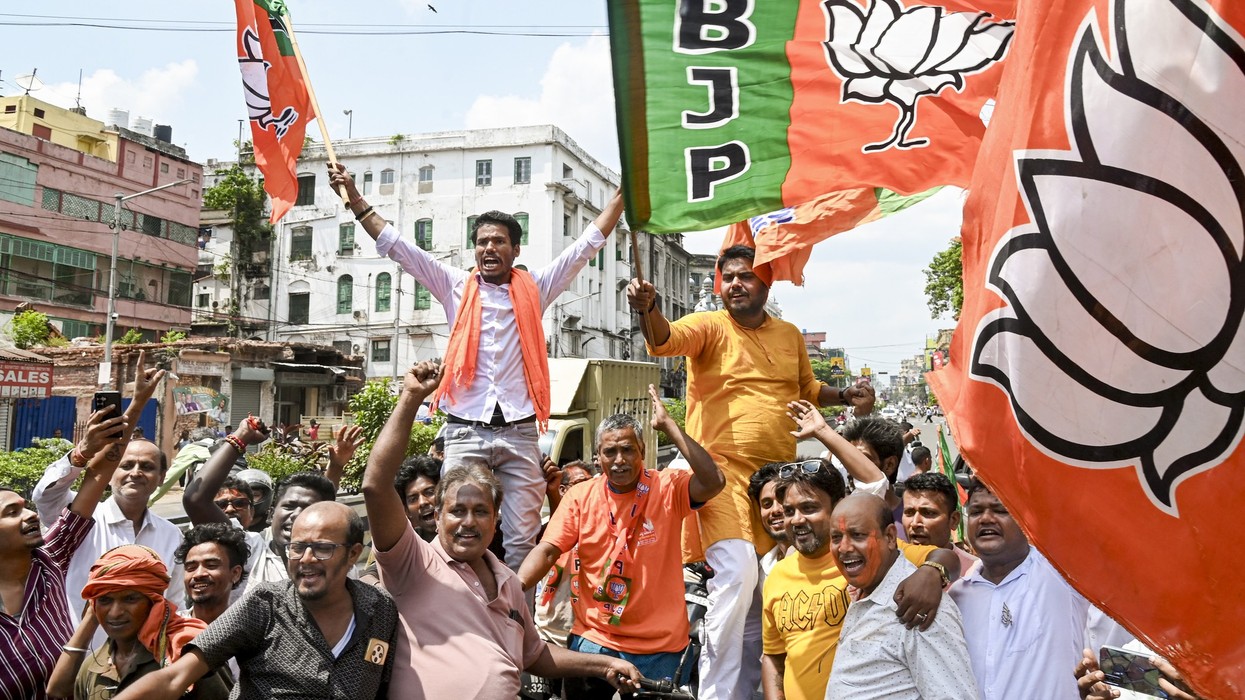
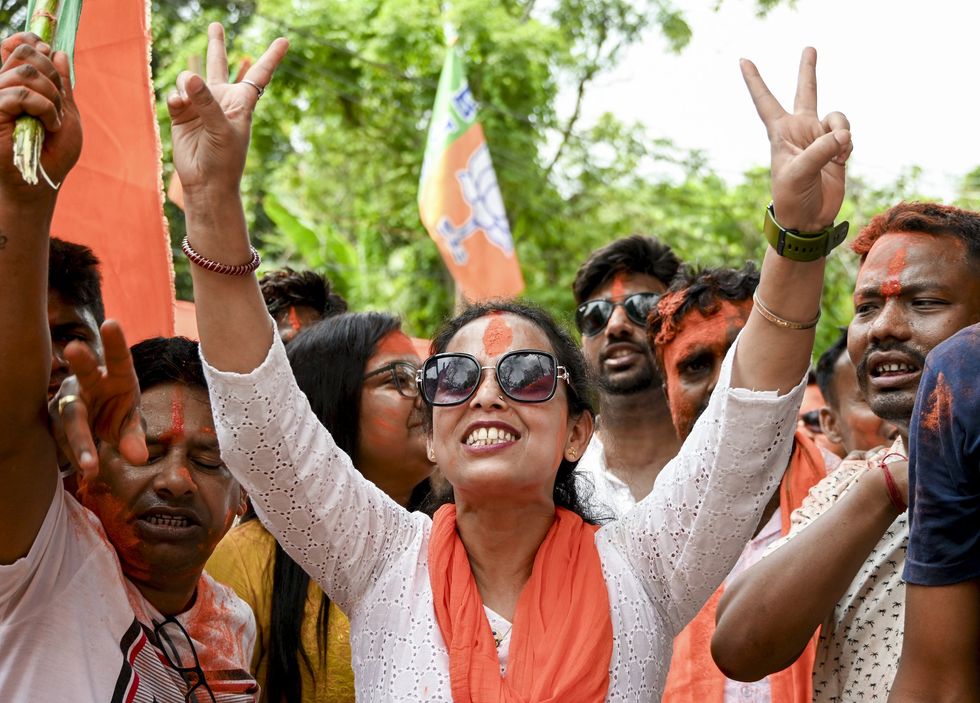 BJP supporters celebrate as the party takes lead during the West Bengal Assembly elections result day, at Raiganj, in Uttar Dinajpur district, Monday, May 4, 2026.PTI
West Bengal emerged as the केंद्र of attention, with early counting trends signaling a major political shift. The BJP surged past the halfway mark in the 294-member Assembly, leading in 185 seats initially and later extending its lead to 192 seats by 2 pm, according to Election Commission data. The TMC trailed significantly with leads in around 91–92 seats.
The majority mark of 148 was breached early, pointing to a possible breakthrough for the BJP in a state dominated by Mamata Banerjee since 2011. The trends suggested a geographically split mandate. The BJP pushed ahead in border areas, tribal belts, and industrial regions, while the TMC retained strength in parts of Kolkata and select rural pockets.
Counting began at 8 am with postal ballots, followed by EVM votes. However, the Election Commission countermanded polls in the Falta constituency due to “severe electoral offences and subversion of the democratic process.”
Despite the broader trend favoring the BJP, Mamata Banerjee maintained a lead in her Bhabanipur seat. She was ahead by 16,706 votes after five rounds, though the margin fluctuated. By the 10th round, her lead narrowed to 12,131 votes, with 41,138 votes against BJP challenger Suvendu Adhikari’s 29,007.
The Bhabanipur contest saw sharp swings. Banerjee led in the first round, trailed in the second, and regained her advantage in subsequent rounds. In Nandigram, however, Adhikari was ahead by over 3,135 votes against TMC’s Pabitra Kar after two rounds.
Trends also indicated deeper structural shifts. The BJP’s vote share rose to about 44.8 percent, while the TMC’s dipped to around 41.7 percent. The BJP held ground in constituencies where voter deletions exceeded previous victory margins and made inroads into areas previously dominated by the TMC.
Several TMC leaders were trailing. In Dinhata, Udayan Guha was behind BJP’s Ajay Ray by 6,259 votes. In Sabang, Manas Ranjan Bhunia trailed BJP’s Amal Kumar Panda. In Kolkata, BJP’s Purnima Chakraborty led over minister Shashi Panja.
The BJP also led in constituencies such as Gosaba, Baghmundi, Bankura, Durgapur Purba, and Rajganj. Meanwhile, the TMC retained leads in areas like Kasba, Ballygunge, Singur, and Jamalpur.
Amid the trends, TMC leader Sagarika Ghose alleged delays in counting.
“Trends for 100 seats have still not been uploaded by the ECI. Why this delay in counting? Why is counting so slow? Why only one or two rounds counted until now?" she asked, adding, "TMC workers are full of spirit and will not move until every vote is counted. Joy Bangla!"
BJP leaders celebrated the performance, calling it a historic mandate and criticizing the opposition alliance, claiming it had “no future.”
Tamil Nadu: Superstar Vijay's TVK surge signals political shift
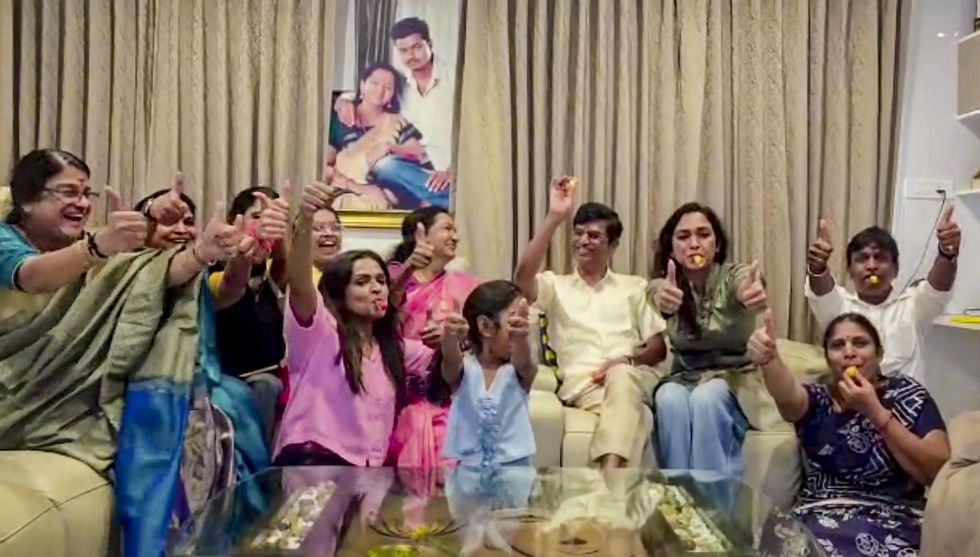 In this screengrab from a video posted on May 4, 2026, Family members of Tamilaga Vettri Kazhagam (TVK) chief Vijay, including S A Chandrasekhar and Shoba, celebrate as early trends show the party leading in the Tamil Nadu Assembly elections, in Chennai. PTI
As of the afternoon of (4), vote counting in Tamil Nadu points to a major and potentially historic shift in the state’s political landscape. Early trends suggest that actor-turned-politician Vijay’s party, Tamilaga Vettri Kazhagam (TVK), has rapidly emerged as a powerful contender, challenging the long-standing dominance of the DMK and AIADMK.
According to the latest data from the Election Commission of India, the contest has taken a triangular shape. TVK is leading in approximately 106 to 110 seats, placing it as the single largest party in the 234-member Assembly and bringing it close to the majority mark of 118 seats. The AIADMK-led alliance is in second place with leads in around 60 to 61 seats, while the ruling DMK-led alliance, which includes Congress and DMDK, is trailing in third position with about 47 to 62 seats.
One of the most striking aspects of the election is TVK’s strong debut performance. Contesting its first-ever Assembly election, the party has made significant inroads, especially in urban areas. Chennai, in particular, has shown strong support for TVK candidates, reflecting a shift in voter preference in key metropolitan constituencies.
The early trends also indicate major upsets. Incumbent Chief Minister M.K. Stalin is reportedly trailing in his long-held Kolathur constituency against TVK candidate V.S. Babu. Udhayanidhi Stalin is also facing a tough contest and is trailing in the Chepauk-Thiruvallikeni seat. These developments suggest a challenging scenario for the ruling DMK in its traditional strongholds.
Vijay himself appears to be performing strongly, leading in both constituencies he contested—Perambur and Tiruchirappalli East. His personal appeal and visibility seem to have played a significant role in boosting the party’s performance across regions.
The AIADMK, while behind TVK, has managed to stay ahead of the DMK in several constituencies. Party general secretary Edappadi K. Palaniswami is maintaining a comfortable lead in his home constituency of Edappadi, indicating that the party retains pockets of strong support.
The election also recorded a high voter turnout of approximately 85.1 per cent during the single-phase polling held on April 23, reflecting strong public participation.
If these trends continue, Tamil Nadu could witness a major political realignment. The rise of TVK signals the possibility of either a non-Dravidian party forming the government or the beginning of a new coalition era, potentially ending decades of alternating rule between the DMK and AIADMK.
In Tamil Nadu, counting was set against the backdrop of a three-cornered contest involving the ruling DMK, AIADMK, and actor Vijay’s Tamilaga Vettri Kazhagam.
BJP spokesperson Narayanan Thirupathy expressed confidence in a win for the AIADMK-led NDA. He dismissed the possibility of a hung assembly and said the DMK was on its way out.
He argued that recent reactions from the DMK and its allies showed they were “rattled.” He also said that Vijay’s entry into politics might split anti-establishment votes but maintained that public sentiment was strongly against the DMK government.
Responding to opposition criticism over LPG issues, he accused Congress and DMK of misleading the public. He stated that India has managed global energy challenges effectively and maintained among the lowest LPG prices.
Thirupathy emphasized that LPG connections had increased significantly and that the central government had borne financial burdens to prevent price hikes.
Kerala: UDF gains momentum; IUML leads in 23 seats
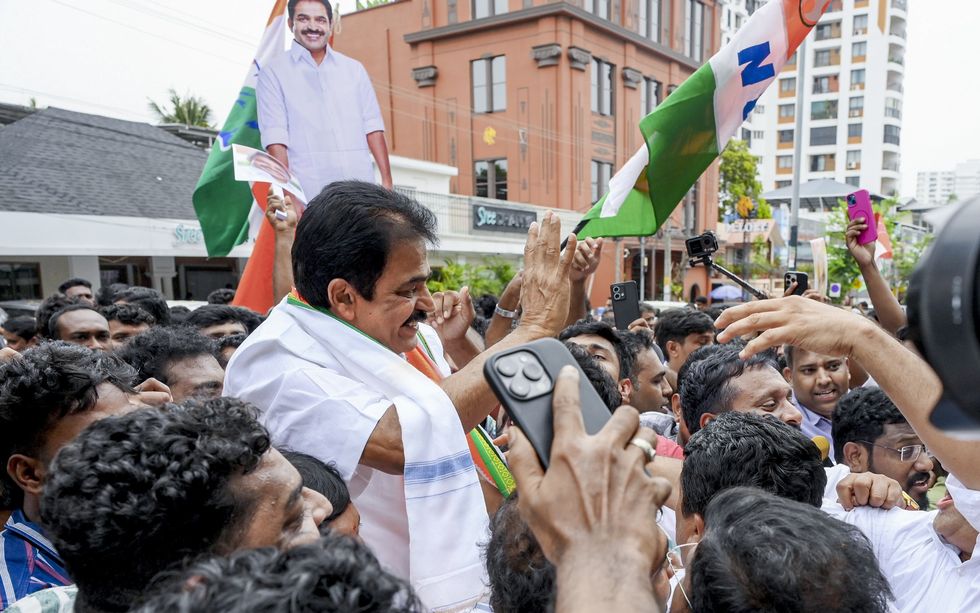 Congress MP KC Venugopal celebrates with party workers as the party takes lead during the Kerala Assembly elections result day outside KPCC office, in Thiruvananthapuram, Monday, May 4, 2026. PTI
In Kerala, the Indian Union Muslim League reported strong performance as part of the United Democratic Front.
The IUML was leading in 23 of the 27 seats it contested. Party leaders credited alliance coordination for the success.
IUML state president Sayyid Sadiq Ali Shihab Thangal said, "This is the result of the UDF’s teamwork reflected in the election. The rest of the matters will be decided after discussions within the UDF."
Senior leader P K Kunhalikutty also projected that the UDF would win around 100 seats. He said discussions on further steps would follow established procedures within the alliance.
Kunhalikutty described the performance as historic and highlighted continued electoral growth. He also pointed to the victory of Congress leader V S Joy in Thavanur as a notable achievement.
Assam: Charan Boro wins Mazbat by over 55,000 votes
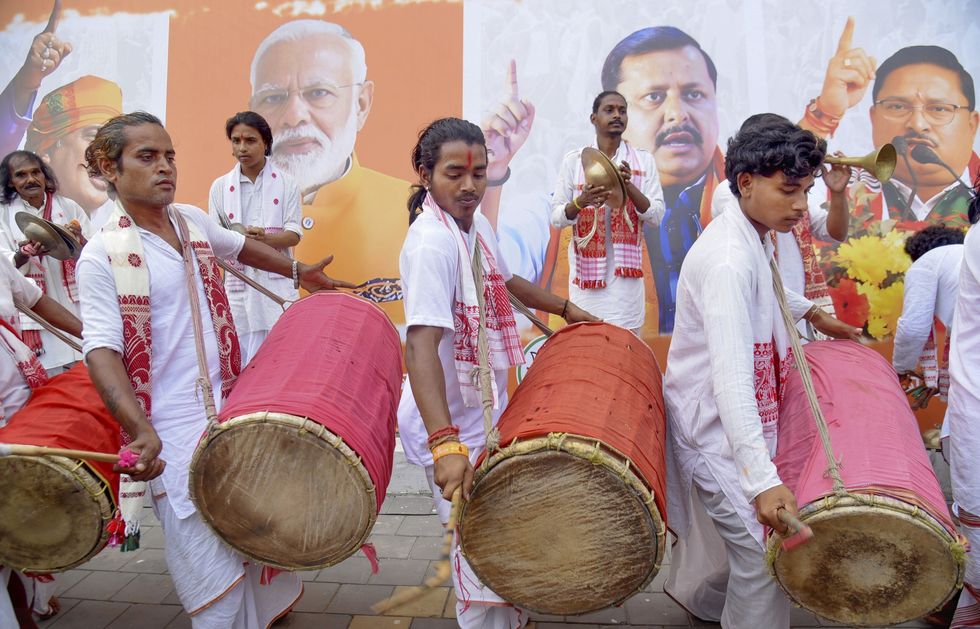 Artists play traditional drums as BJP workers celebrate the party taking lead during the Assam Assembly elections results day, at party headquarters, in Guwahati, Monday, May 4, 2026. PTI
In Assam, cabinet minister and BPF leader Charan Boro secured a decisive victory in the Mazbat constituency.
Boro received 84,718 votes, defeating JMM candidate Priti Rekha Barla, who secured 29,172 votes. The margin of over 55,000 votes marked his third consecutive win.
Boro is part of the BJP-led NDA government and had been inducted into the ministry after his party joined the coalition.
Puducherry: AINRC leads in multiple constituencies
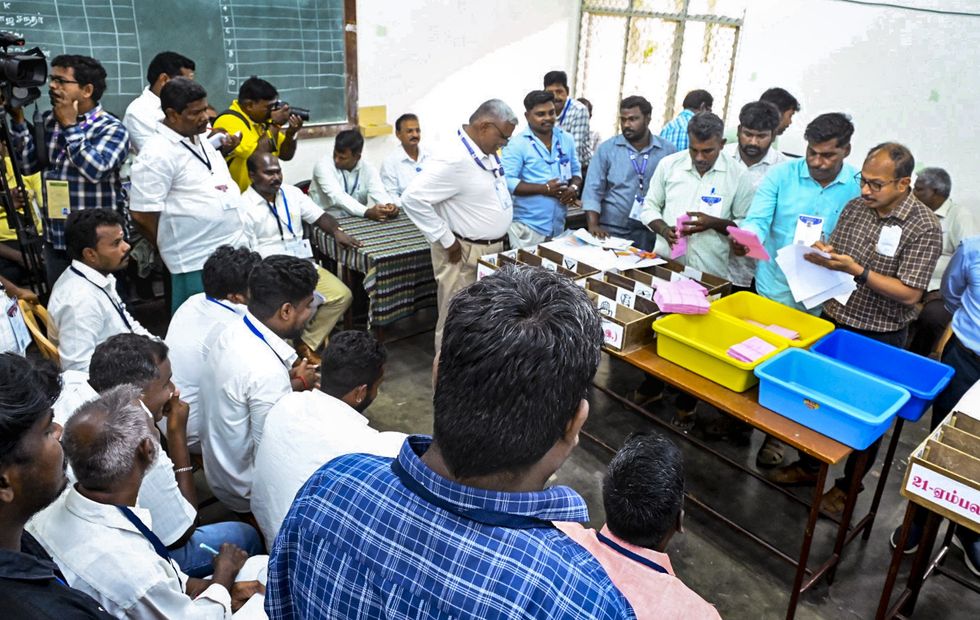 Puducherry: Poll officials during the counting of votes for the Puducherry Assembly elections at a counting centre, in Puducherry, Monday, May 4, 2026. PTI
In Puducherry, chief minister N Rangasamy and his AINRC party candidates were leading in several constituencies.
Rangasamy himself was ahead in Thattanchavady by 3,591 votes. Other AINRC candidates led in Villianur, Muthialpet, Ariankuppam, Enbalam, Nettapakkam, and Karaikal North.
BJP candidates also showed leads in Mannadipet and Neravy T R Pattinam constituencies.
These trends indicated a favorable position for the ruling alliance in the Union Territory.
Overall, the counting day reflected shifting political dynamics across states, with West Bengal standing out as the most dramatic battleground, while other regions showed a mix of continuity and emerging challenges for established parties.