
Highlights:
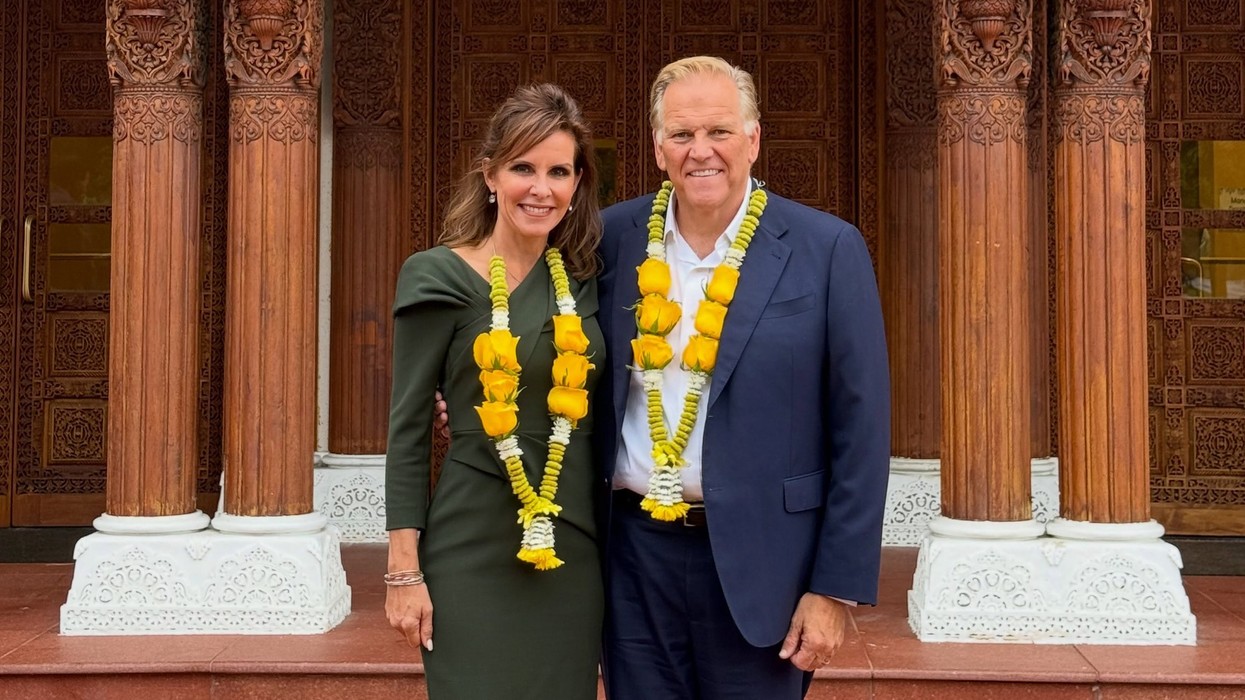
Republican Senate candidate Mike Rogers recently visited a Hindu temple in Canton, Michigan, bringing renewed attention to religious issues surrounding the state’s closely watched Senate race.
The visit comes amid a wider political debate involving Hindu organizations, India-related issues and allegations of anti-Hindu and anti-India sentiment. The appearance has also been linked to discussions surrounding BAPS, the Bochasanwasi Akshar Purushottam Swaminarayan Sanstha, which has a temple in Canton.
BAPS is a global Hindu organization with temples and community centers in several countries, including the United States. Its activities have periodically attracted political and public scrutiny.
The Firstpost report connects Rogers’ temple appearance with the current controversy, while also highlighting remarks and political attacks involving his Democratic opponent, Abdul El-Sayed.
Debate over anti-Hindu sentiment
The controversy comes as concerns over anti-Hindu rhetoric and discrimination have received greater attention in American public life.
Hindu American organizations and community advocates have spoken publicly about what they describe as hostility toward Hinduism and India. In July, Democratic Representatives Shri Thanedar and Raja Krishnamoorthi called for action against what they described as anti-India hatred and encouraged members of the Indian diaspora to participate more actively in civic life.
Those broader concerns form part of the backdrop to Rogers’ visit, although there is no independently verified evidence establishing that a specific anti-Hindu incident prompted the Republican candidate’s appearance at the Canton temple.
The distinction is important because a temple visit alone does not establish why a candidate chose to attend or what political message the appearance was intended to convey.
Rogers campaign targets El-Sayed
Rogers is running against Democrat Abdul El-Sayed for Michigan’s open U.S. Senate seat.
El-Sayed, a former Detroit health official, won the Democratic primary and is now facing Rogers in the general election. The Republican campaign has focused heavily on El-Sayed’s positions on Israel and Gaza, as well as his associations with political commentators.
The Democratic candidate has also become the target of attacks over his Muslim faith and his political views. Democrats have accused Republicans of using Islamophobic rhetoric against El-Sayed, while Rogers and his campaign have continued to focus on national security and foreign policy.
The competing accusations have made religion a recurring part of the Michigan Senate campaign.
Michigan race remains closely watched
The contest has attracted national attention because Michigan is considered an important state in the battle for the Senate.
A Washington Post-Schar School poll published September 17 found El-Sayed at 48% and Rogers at 45% among Michigan likely voters. The poll had a margin of error of 3.9 percentage points.
Campaign spending has also reached significant levels. The Associated Press reported that spending in the Michigan Senate contest had surpassed $125 million.
Against that backdrop, Rogers’ appearance at a Hindu temple has become another point of interest in the campaign.
The visit does not by itself establish a position on the allegations of anti-Hindu or anti-India sentiment. It does, however, place the Republican candidate at a Hindu religious institution while those issues are part of the broader political conversation surrounding the race.
As the election approaches, the candidates’ statements, campaign appearances and responses to questions involving religion and foreign policy are likely to remain closely scrutinized.