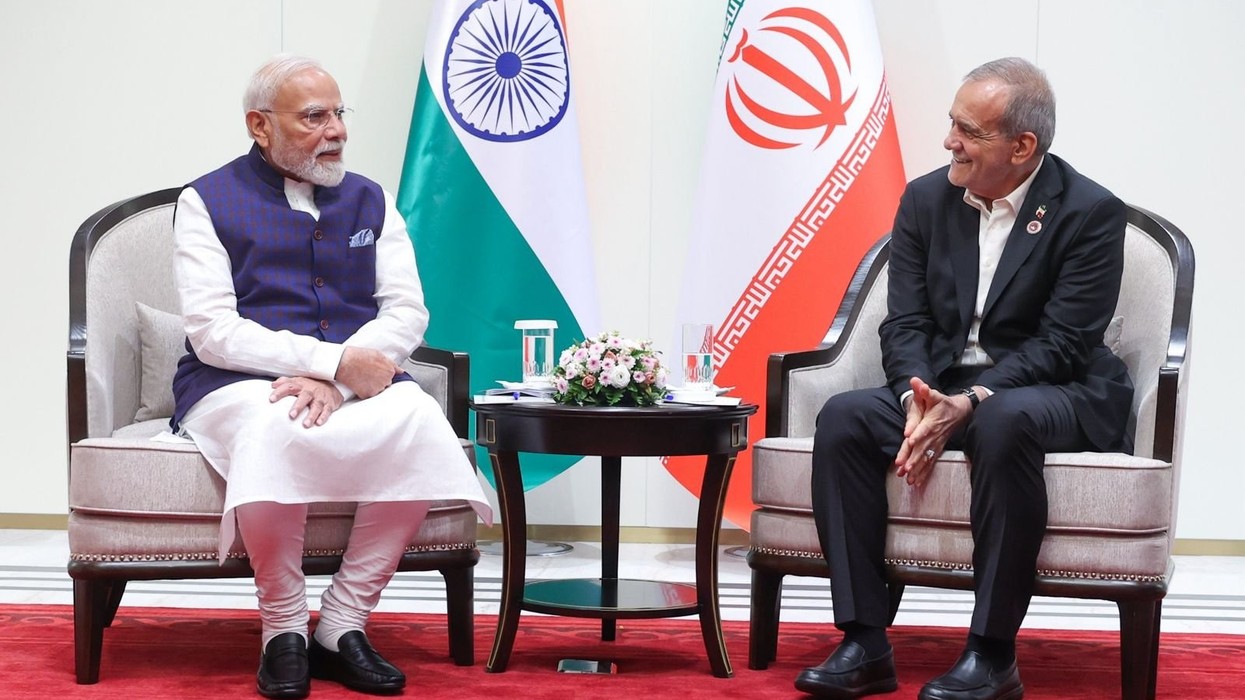

Indian prime minister Narendra Modi’s meeting with Iranian president Masoud Pezeshkian on the sidelines of the Shanghai Cooperation Organisation (SCO) summit in Bishkek on Monday (31) carries significance beyond the usual diplomatic engagement.
The talks come at a sensitive moment for India’s foreign policy, with tensions between Iran and the United States continuing to shape the wider geopolitical and energy landscape. At the same time, New Delhi has been working to strengthen its relationship with Washington while maintaining long-standing ties with Moscow and Tehran.
Modi and Pezeshkian discussed expanding economic ties and the regional situation. Modi also held a separate meeting with Armenian Prime Minister Nikol Pashinyan.
Modi signals deeper engagement with Iran
After meeting Pezeshkian, Modi said India remained committed to strengthening its long-standing relationship with Iran.
"Met President Masoud Pezeshkian in Bishkek. Reiterated our commitment to strengthening India's long standing friendship with Iran across diverse sectors," the prime minister said on social media.
He added: "We want to expand and diversify our trade basket in the times to come. We had a discussion on the prevailing situation in the region. India will continue to support all efforts aimed at ensuring lasting peace."
The emphasis on expanding and diversifying trade is important. India and Iran have traditionally maintained cooperation in areas including connectivity, energy, pharmaceuticals and trade, despite pressure from international sanctions and changing regional alliances.
The meeting also comes as the conflict involving Iran continues to create uncertainty for global energy markets and regional security. India has repeatedly maintained that disputes should be resolved through dialogue and diplomacy.
Why Washington will be watching
The meeting could also have implications for the India-US relationship, although there is no indication that New Delhi intends to use the Bishkek talks to challenge Washington directly.
India and the United States recently emerged from a difficult period in their economic relationship after disagreements over tariffs and India's continued economic engagement with Russia. Washington's pressure on countries maintaining close commercial links with Moscow demonstrated the limits of India's room for manoeuvre.
Iran presents another sensitive issue.
The United States has maintained strong pressure on Tehran, while India has sought to preserve its ability to engage with Iran based on its own economic and strategic interests. Any expansion of India-Iran trade could therefore attract attention in Washington, particularly if energy becomes a larger part of the relationship.
For New Delhi, however, maintaining communication with Tehran is consistent with its broader policy of strategic autonomy. India wants strong ties with the United States without abandoning relationships that remain important to its national interests.
A balancing act, not a shift in alignment
Modi's presence at the SCO summit also placed him alongside leaders including Russian President Vladimir Putin and Chinese President Xi Jinping, reinforcing the complexity of India's diplomatic positioning.
Yet the meeting with Pezeshkian should not automatically be interpreted as India moving away from the United States. Rather, it reflects New Delhi's preference for keeping multiple diplomatic channels open.
Modi also met Armenian prime minister Nikol Pashinyan, with discussions covering defence, IT, space, education, pharmaceuticals, trade and investment.
For now, the immediate story is straightforward: Modi met Iran's president in Bishkek and signaled India's intention to strengthen ties with Tehran. What that means for the broader India-US relationship will depend on how far those ties develop, particularly in trade and energy.
At present, the focus remains on the Modi-Pezeshkian meeting itself — and India's attempt to maintain an independent diplomatic path while navigating an increasingly divided global order.