
Highlights:
- Indian Americans make up 1.5 per cent of the US population but drive 8 per cent its tech startups.
- Over 262,000 Indian-origin doctors serve in the American healthcare system.
- Sixteen Indian-origin CEOs lead Fortune 500 companies
- The community contributes $150 billion annually to the US economy.
- Cultural exports like yoga, Bollywood, and Indian festivals have become mainstream in the US.
Indian Americans are at the forefront of America’s technological revolution. Icons like Sundar Pichai (Google), Satya Nadella (Microsoft), and Arvind Krishna (IBM) lead corporations that shape how billions live and work. Between 2018 and 2023, first-generation immigrant founders, many of them Indian, launched 55 per cent of the US’s 648 unicorn startups. Collectively, Indian American-led ventures are valued at over $195 billion, employing more than 55,000 professionals in sectors like AI, fintech, and biotech.
Silicon Valley, long hailed as the innovation capital of the world, would look drastically different without Indian engineers, developers, and scientists driving research and product breakthroughs. The community’s focus on education and technology continues to strengthen America’s global edge in digital transformation.
How have Indian Americans transformed the US healthcare system?
The healthcare workforce in the US would struggle to function without Indian-origin professionals. Of America’s 987,000 doctors, about 10 per cent, nearly 100,000 are Indian-origin physician, making them the largest immigrant group in medicine. Their service is especially vital in rural and underserved areas, where many take on essential roles in primary care.
The Covid-19 pandemic underscored their contribution as Indian-American doctors led intensive care efforts and research on vaccines and treatments. In addition, Indian-origin nurses form the second-largest group of registered foreign nurses, helping bridge the national shortage of medical personnel. Their expertise extends to cutting-edge medical research, including advancements in oncology, biotechnology, and precision medicine.
Why are Indian Americans considered economic powerhouses?
Indian Americans, though only 1.5 per cent of the US population (5.2 million), generate an outsized economic impact. They produce $150 billion in annual business revenue, create 800,000 jobs, and own about 60 per cent of US hotels and motels.
Around 8 per cent US tech startups are founded by Indian entrepreneurs, and nearly 4 per cent of Fortune 500 firms are led by Indian-origin CEOs. These achievements are powered by exceptional educational attainment, 75 per cent hold bachelor’s degrees or higher, compared to the national average of 33 per cent.
How many Indians enroll annually in US universities?
Indian-origin students represent the largest international student group in the US, with 331,833 enrolled in 2023–24, a growth of over 20 per cent in one year. These students are spread across 842 US institutions, with a concentration in graduate and professional programs focusing on STEM and analytics.
Arizona State University leads with nearly 600 new Indian enrollments, followed by California’s Fresno State (291) and San Jose State (160). Texas universities like University of North Texas (186) and University of Houston (167) also attract large numbers due to affordability and career opportunities.
At elite universities, Indian enrollments tend to be smaller and more graduate-focused, e.g., Carnegie Mellon with 44 new Indian students, while others like UC Berkeley saw declines in undergraduate Indian enrollments. The trend highlights a strategic shift toward applied graduate education in STEM fields, prioritizing affordability and career ROI over prestige alone.
Not just white-collar, Indians contribute in blue-collar jobs as well
Indian immigrants fill vital blue-collar roles in trucking, warehousing, agriculture, convenience stores, cleaning, and elder care, a presence especially strong in California, Texas, and New Jersey. Indians account for up to 15 per cent of US trucking company owners and a sizable share of convenience stores, contributing billions annually to logistics and retail.
In cleaning and elder care, Indian Americans are estimated to cover 8–12 per cent of the workforce, supporting essential services for millions.
With nearly 29 per cent of the overall US workforce now immigrant-origin and birth rates falling, the absence of Indian blue-collar workers would severely impact supply chains, healthcare, and daily life, causing acute labor shortages and economic disruption
How has Indian culture enriched American society?
Indian traditions have seamlessly woven into the fabric of American life. Yoga, originating from ancient India, now attracts over 34 million practitioners across the US, evolving into a $12 billion wellness industry. Cultural festivals like Diwali and Holi are celebrated in schools, cities, and workplaces, symbolizing inclusivity and cross-cultural respect.
Indian cuisine is another beloved import, with Indian restaurants now accounting for 3 per cent of Michelin-starred dining experiences in the US. Meanwhile, Bollywood films, music, and fashion have gained a loyal American audience, fostering mutual appreciation between the two nations.
This cultural influence extends to Hollywood and beyond, where Indian American actors, writers, and filmmakers are redefining representation and diversity.
How are Indian Americans influencing policy and diplomacy?
Beyond business and culture, Indian Americans are shaping US public life and global diplomacy. Sixteen Indian-origin executives currently head Fortune 500 firms, offering leadership that shapes global corporate policies. In government, Indian Americans hold influential positions, from local councils to federal offices, impacting immigration, foreign policy, and trade relations.
Political engagement has surged in recent years, with rising voter participation and leaders like Zohran Mamdani and Raja Krishnamoorthi representing new waves of activism. In academia, Indian American scholars contribute immensely to research and education, influencing global thought in science, economics, and international affairs.









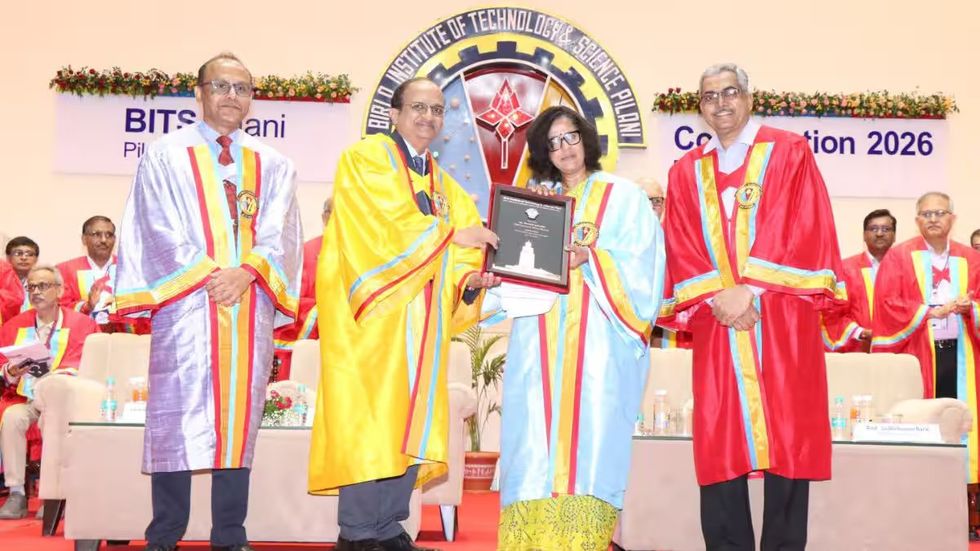 Receiving a memento during the BITS Pilani Convocation 2026BITS
 Amish Shahx