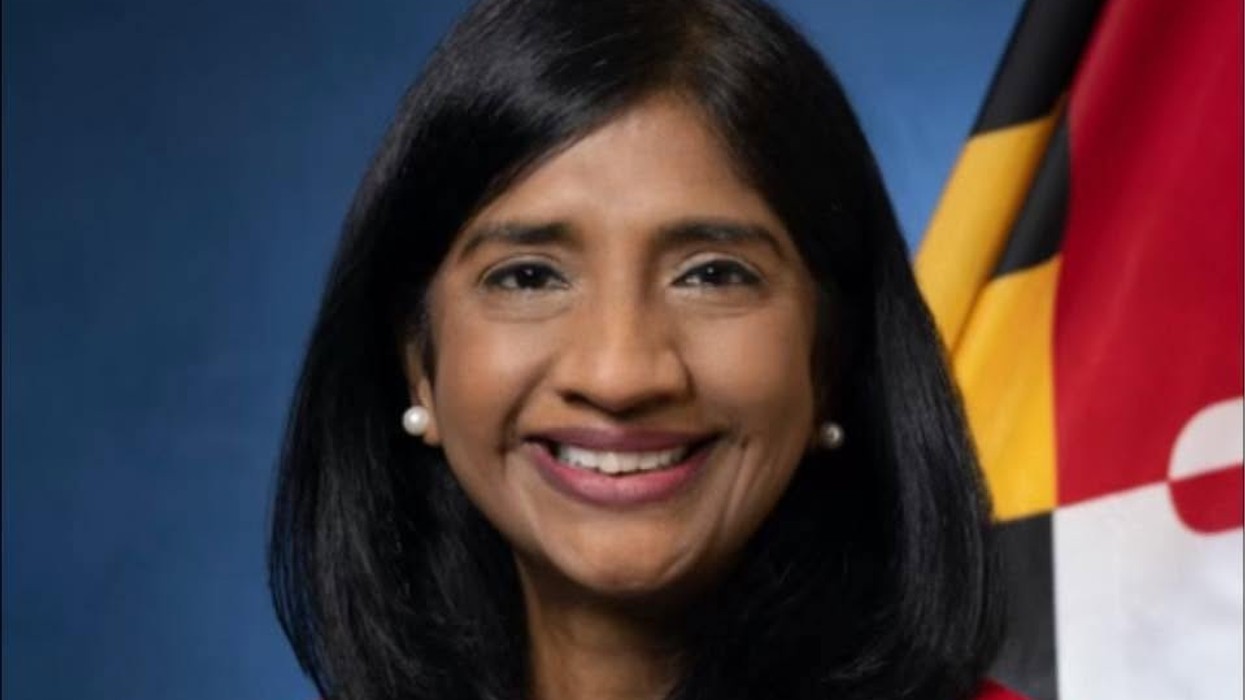

Highlights:
- Aruna Miller, Maryland's lieutenant governor, is the first immigrant and first person of color elected to statewide office there.
- She arrived in the US from Hyderabad at age seven, when she was often the only Indian student in her class and school.
- Miller says south Asian success in medicine, technology and business must now translate into greater political representation.
- She points to Maryland's Immigrant Rights Protection Task Force and an expanded Community Trust Act as recent wins for immigrant communities.
- Miller is running for a second term as lieutenant governor alongside Gov. Wes Moore in the November 3 election.
WHEN Aruna K Miller arrived in the US from India at the age of seven in the 1970s, being Indian American often meant standing out.
"There wasn't much south Asian community here. And so when I walked into classrooms, I typically ended up being the only Indian person in the entire class and the whole school," Miller told India Weekly in an exclusive interview.
Today, Miller is Maryland's lieutenant governor, the 10th person to serve in the office, and the first woman and first person of color and immigrant elected to statewide office in Maryland. She took office in January 2023.
Her journey reflects the transformation of the Indian American and broader south Asian community in the US.
"I think since the IT boom has taken place, you see a lot more changes and a lot more diversity when it comes to Indian Americans that have called the United States their home," she said.
"And, in particular, Maryland."
She said south Asian Americans are now represented across education, science, entrepreneurship, business and public service.
"I've seen a tremendous change in our community since the time I arrived in the early 1970s to here we are in the 21st century," Miller said.
Maryland has a large immigrant population, with foreign-born residents accounting for about 17 per cent of the state's population, according to the Maryland government.
The belonging question
But for Miller, the bigger issue is whether immigrants feel they belong.
"What immigrant communities are seeking is to feel like they have a sense of belonging here in our country, in our state, in our communities, in their homes, in their own skin," she said.
Representation can help build that connection, she said.
"When they see individuals that perhaps reflect their lived experiences, they feel a little bit more comfortable, especially in areas of leadership," Miller said.
Born in Hyderabad, India, on November 6, 1964, Miller moved to the US with her family at seven. She earned a bachelor's degree in civil engineering from the University of Missouri-Rolla, now Missouri University of Science and Technology, in 1989. Before entering elected office, she worked in transportation and engineering, including in Montgomery County, Maryland.
Miller was appointed to the Maryland House of Delegates in December 2010 and began serving in January 2011.
She represented District 15 through January 2019 and later served on the Maryland State Ethics Commission from 2019 to 2021.
As lieutenant governor, her policy portfolio includes transportation, mental health and STEM equity. She chairs the Governor's Work Zone Safety Work Group and Maryland's Council on Interfaith Outreach.
Immigration remains one of the areas where Miller's personal history and public role intersect most directly.
"A lot of immigration laws come from the federal level. So the states have very little power on what we can do. But what we can do is making sure immigrants feel at home and safe in our state," she said.
Maryland created a statewide Immigrant Rights Protection Task Force in June 2026 and expanded the Community Trust Act this year, which places restrictions on certain state and local actions related to immigration enforcement.
Miller also pointed to the state's Office of Immigrant Affairs and its efforts to help immigrants navigate government services and pursue citizenship.
"There are a lot that came here on H-1B visas, and they add to the economy. They're taxpayers, their kids often go to school here. They build a whole community here, but yet they can't, they're standing in this long line of getting their green card and getting their citizenship. So we're trying to make progress in those areas," she said.
A message on civic participation
But Miller's strongest message to south Asian Americans is about political participation.
She believes professional success in medicine, technology, business and other fields needs to be matched by greater civic engagement.
"One area our community needs to really focus on is in politics," she said.
Some south Asian immigrants continue to feel detached from American civic life even after becoming citizens, she added.
"Oftentimes my experience has been in observing our community is that when they come here, even after becoming citizens, they still feel like this country is borrowed land," she said.
"And it's not. You chose purposely to become a citizen of this country," Miller said. "Which means that you need to be engaged in policymaking, in voting, in running for office, because these are where much of the decisions that impact our daily lives happen."
For Miller, civic engagement is inseparable from everyday life.
"From the moment we wake up till the moment we close our eyes, policy making is impacting our lives. And that's why, yes, you can be a physician... an entrepreneur, but you have to be engaged civically."
That is also why Miller has spoken about not wanting to be the "first and only." She believes the community needs organisations that actively encourage civic participation and help build a stronger pipeline of political candidates.
"One of the areas that's helpful is to have organisations whose whole purpose is to get our community engaged," she said.
Miller pointed to her previous work with Indian American Impact, which she said helped encourage south Asian candidates to run for office and supported them financially.
She also believes community support has to go beyond money.
"I have a lot of love and affection I get from our south Asian community. And they'll come up to me and they'll give me a pat on the back and they'll say, oh, we're so proud of you, honey.
"We're so proud of everything you've done. But you know what? That needs to translate to more than just words. You need to be able to support candidates who are running for office."
Miller said she is seeing signs of change as more south Asian candidates run for office.
"It's changing because they're beginning to see candidates that look like themselves running for office, and that gets them more engaged," she said.
For Miller, broader participation strengthens democracy.
"It makes it so much stronger because you cast that electoral net really wide when you have new people, new Americans coming in and voting for the first time, being civically engaged, getting into public service and public policy. These are all the lanes that we need to be in."
The American dream, redefined
Her own understanding of public service began with her experience as an immigrant and as a student.
Miller said she arrived in the US without speaking English and credits public educators with teaching her the language and showing her what was possible. "I came here, I didn't know a word of English when I came here. And it was the public educators that taught me English, and they taught me that I could be anything that I wanted to be in this country."
She later relied on Pell Grants while attending college.
"It was the taxpayers that contributed to those grants so I could graduate as a civil engineer," she said.
That experience shaped her decision to enter public service.
"And I knew as soon as I graduated that I wanted to devote my life to giving back to a country that gave me so much. So I chose public service as an engineer. I was a public servant working at a local government, and I had this tremendous opportunity to become a lieutenant governor."
Miller is now seeking a second term alongside Gov. Wes Moore. The ticket won the Democratic gubernatorial primary on June 23 and is on the ballot for the November 3 general election.
In July, Miller was elected treasurer of the 2026-2027 Executive Committee of the National Lieutenant Governors Association. Yet her own definition of the American dream remains personal.
"I can't tell you what it means to every south Asian young American, because dreams are really individual and unique to yourself."
For Miller, that dream has always centered on opportunity.
"There are so many opportunities that are available for them to be successful." She sees her own journey as proof.
"And so my dream has been accomplished, I can tell you that, because I've always wanted to help people in the broadest way possible. And public service gives me that opportunity to do so."
And her message to the community that has grown so dramatically since she arrived in America is equally direct.
"Everyone, it's up to them how they make those dreams come true."







 A visitor holds a baby at the Empty Sky 9/11 Memorial with One World Trade Center and Lower Manhattan in the distance on August 23, 2026 in Jersey City, New Jersey.Getty
 American flags and flowers line the memorial pool at the National September 11 Memorial to mark the 22nd anniversary of the 9/11 terror attack at the World Trade Center on September 11, 2023 in New York.Getty
 Balbir Singh Sodhi, a Sikh immigrant from India, was shot and killed outside the gas station he owned in Mesa, Arizona. .
 Muslim men pray during a Day of Remembrance open house at the Islamic Cultural Center of New York September 11, 2002 in New York City. Getty

