
Highlights:
- Delhi's AQI stood at 265 on November 21, remaining in the 'poor' category for the third consecutive day of gradual improvement.
- Vehicle emissions accounted for 33.1 per cent of the estimated PM2.5 pollution load.
- DTU recorded the worst air quality with an AQI of 362, while Cantonment recorded 80.
- The pollution forecast warns that Delhi's air could deteriorate to the 'very poor' category over the following six days.
- A survey found that 86 per cent of children reported health effects from pollution, while nearly 55 per cent missed school due to illness.
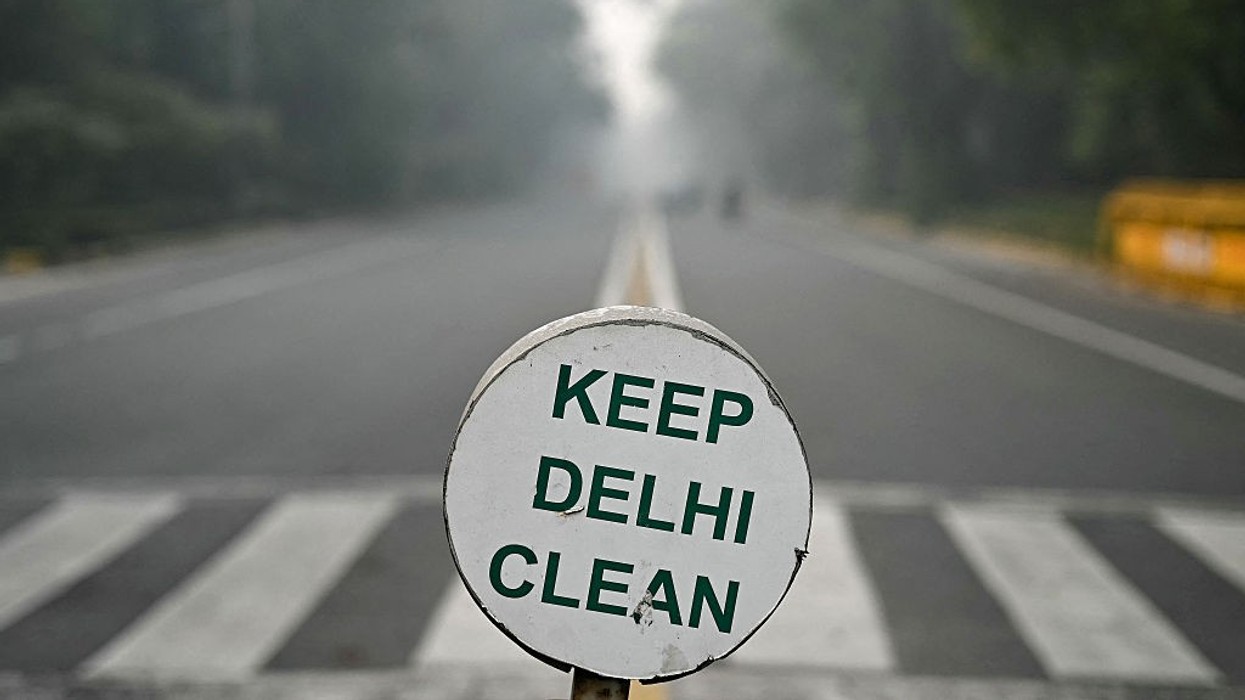
Delhi's air quality remained in the 'poor' category on Saturday, November 21, with the Air Quality Index (AQI) settling at 265. Although pollution levels have declined gradually over the past three days, vehicle emissions continue to be the largest estimated contributor to the city's fine particulate pollution.
According to data from the Central Pollution Control Board (CPCB), Delhi's AQI improved from 280 on November 19 to 270 on November 20 and 265 on Saturday (21). However, the improvement does not mean that the air is safe to breathe, particularly for children, older adults and people with existing respiratory conditions.
Of the 56 air quality monitoring stations that recorded data, 32 reported 'poor' air quality, 16 were in the 'very poor' category, seven recorded 'moderate' levels and one station reported 'satisfactory' air quality.
Delhi Technological University (DTU) recorded the city's highest AQI at 362, followed by North Campus at 360 and Siri Fort at 352. The Cantonment area recorded the lowest AQI at 80, placing it in the 'satisfactory' category.
What is causing Delhi's air pollution?
Vehicle emissions emerged as the biggest contributor to Delhi's estimated PM2.5 pollution load on Saturday, accounting for 33.1 per cent, according to real-time source apportionment estimates from the Air Quality Early Warning System.
PM2.5 refers to fine particulate matter measuring 2.5 micrometers or less in diameter. These particles are particularly concerning because they can travel deep into the lungs and, in some cases, enter the bloodstream. Exposure can aggravate asthma, contribute to respiratory problems and increase the risk of cardiovascular complications.
The estimated contribution from different pollution sources on Saturday was:
- Vehicle emissions: 33.1 per cent
- Secondary organic aerosols: 16.5 per cent
- Biomass burning: 13.9 per cent
- Secondary inorganic aerosols: 9.6 per cent
- Waste burning: 9.5 per cent
- Firecrackers: 7.7 per cent
- Industrial sources: 3.3 per cent
- Mixed combustion: 2.7 per cent
- Road dust and soil: 2.4 per cent
- Coal combustion: 1.3 per cent
Secondary organic and inorganic aerosols are pollutants formed in the atmosphere when gases released by vehicles, industries and other sources react with one another. They contribute to the fine particles present in polluted air.
Biomass burning includes agricultural residue burning, commonly known as stubble burning, as well as the use of domestic solid fuels such as wood and dung cakes.
The figures indicate that Delhi's pollution is not caused by a single source. Traffic, fuel combustion, waste burning, agricultural fires and chemical reactions in the atmosphere all contribute to the city's pollution burden.
Will Delhi's air quality improve over the next few days?
The Air Quality Early Warning System has forecast that Delhi's AQI is likely to remain in the 'poor' category on Sunday. It could deteriorate to the 'very poor' category over the following six days.
Weather conditions play an important role in determining how quickly pollutants disperse. Wind speed, atmospheric mixing height and the ventilation index influence whether pollution accumulates near the ground or spreads into the atmosphere.
The predicted maximum mixing depth over Delhi was approximately 1,400 metres on November 21 and 22. It was expected to decline to 1,150 metres on November 23 and 1,000 metres on November 24.
The ventilation index, which indicates the atmosphere's ability to disperse pollutants, was forecast at 3,600 square metres per second on Saturday, increasing to 5,200 on Sunday and 6,000 on Monday before falling to 3,000 on Tuesday.
According to the Early Warning System, a ventilation index below 6,000 square metres per second, combined with average wind speeds below 10 kilometres per hour, creates unfavorable conditions for pollutant dispersion.
When winds are weak and atmospheric mixing is limited, pollutants can remain concentrated close to the ground, increasing the amount of polluted air people breathe.
What does Delhi's AQI of 265 mean for health?
Under the CPCB's classification, an AQI between zero and 50 is considered 'good', 51-100 'satisfactory', 101-200 'moderate', 201-300 'poor', 301-400 'very poor' and 401-500 'severe'.
At 265, Delhi remains firmly within the 'poor' category. This means prolonged exposure can cause breathing discomfort, including among people without existing respiratory conditions. Those with asthma or other lung and heart conditions may face greater risks.
Doctors have also highlighted the growing impact of air pollution on children's health.
A survey cited by doctors found that 86 per cent of children believed polluted air was affecting their health, while 44 per cent had visited a doctor for pollution-related symptoms. Nearly 55 per cent had missed school because of illness.
The findings also indicated that around 85 per cent of children continued to experience symptoms even when using N95 masks and air purifiers.
"Rising air pollution is becoming a serious health concern for children. The findings are worrying: 86 per cent children believe polluted air is affecting their health, 44 per cent have visited a doctor for pollution-related symptoms and nearly 55 per cent have missed school due to illness. Even among children using N95 masks and air purifiers, around 85 per cent continue to experience symptoms," a doctor said.
Children are particularly vulnerable because their lungs are still developing. Prolonged exposure to PM2.5 can trigger inflammation in the airways, worsen asthma and potentially affect lung development and respiratory health over time.
Doctors have also noted that children are increasingly avoiding outdoor activities, including sports and play, to reduce their exposure to polluted air.
What precautions should families take?
With pollution expected to remain elevated, health experts recommend limiting strenuous outdoor activities, particularly when AQI levels are high. Children, older adults and people with respiratory or cardiovascular conditions should take extra care.
Using a well-fitting N95 mask when outdoors can reduce exposure to fine particles. Keeping windows closed during periods of particularly high pollution, using appropriately sized indoor air purifiers and avoiding indoor sources of smoke can also help reduce exposure.
However, protective measures cannot eliminate the health risks associated with prolonged exposure. The continued symptoms reported by children underline the need for broader action to reduce pollution at its sources, particularly vehicle emissions, waste burning and other forms of combustion.
How was Delhi's weather on Saturday?
Delhi recorded relatively mild temperatures on Saturday (21). The maximum temperature at Safdarjung was 27.6 degrees Celsius, 0.2 degrees below normal.
Palam recorded a high of 25.4 degrees Celsius, 2.2 degrees below normal, while Lodhi Road reached 27.3 degrees Celsius, 0.3 degrees above normal. The Ridge and Ayanagar recorded maximum temperatures of 26.2 and 26.4 degrees Celsius, respectively.
The minimum temperature at Safdarjung was 12.2 degrees Celsius, marginally below normal. Palam recorded 12.5 degrees Celsius, while Lodhi Road registered 13 degrees Celsius. The Ridge and Ayanagar recorded minimum temperatures of 13.1 and 11.5 degrees Celsius, respectively.
Despite the gradual improvement in AQI, the forecast suggests that Delhi residents may continue to face elevated pollution levels in the coming days.