
Highlights:
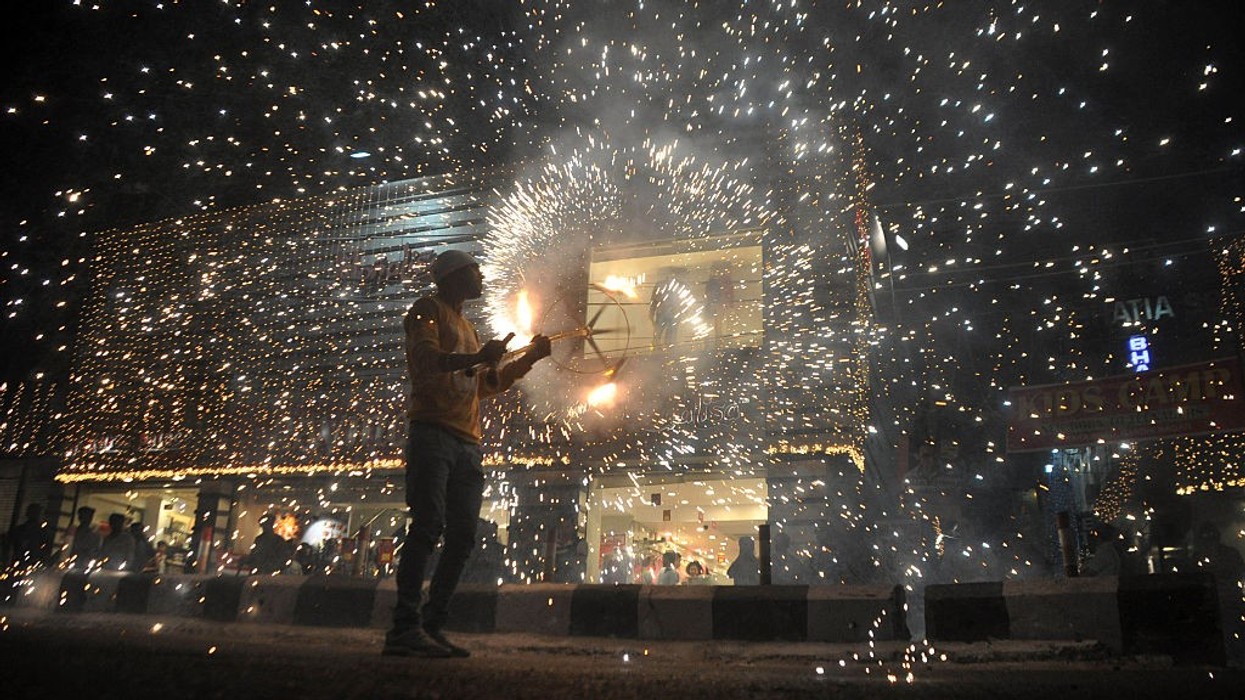
Every year, as Diwali approaches, one debate returns to India's public conversation: should people be allowed to burst firecrackers during the festival, or should their use be restricted to protect the environment?
What begins as a discussion about air pollution, public health and noise often develops into a much larger argument about religious freedom, cultural identity and whether the government or courts have the right to influence how people celebrate a major festival.
The controversy has resurfaced in 2026. On November 2, India's Supreme Court allowed the use of certified green firecrackers in Delhi-NCR on November 7 and 8, subject to strict time limits and other conditions. A complete ban will return on November 9.
The decision has once again brought two competing concerns into focus: the environmental consequences of fireworks and the importance of Diwali traditions to millions of people.
But why does this disagreement return almost every year? And why does a question about pollution so frequently become a religious and political controversy?
Why does the firecracker debate return every Diwali?
The timing is one major reason.
Diwali is celebrated in October or November, depending on the Hindu lunar calendar. In northern India, particularly Delhi, the festival coincides with a period when air quality is already vulnerable to deterioration.
Seasonal weather conditions can make it harder for pollutants to disperse. Lower temperatures, slower winds and atmospheric conditions can contribute to pollution building up near the ground. Emissions from vehicles, industries, construction and other sources also affect urban air quality.
In parts of northern India, agricultural residue burning has been another seasonal contributor to pollution. This means Diwali fireworks are not the only source of the problem, but they can add to an already difficult situation.
Firecrackers release smoke and particulate matter, as well as gases and chemical compounds. Their effects can be particularly concerning for people with respiratory conditions, children, older adults and others vulnerable to poor air quality.
The debate therefore returns because Diwali falls during a period when pollution is already a major public concern. Every year, authorities face pressure to limit additional emissions, while residents and businesses prepare for a festival in which fireworks remain an established part of celebrations.
Why has the Supreme Court become involved?
The issue has been the subject of legal proceedings for years.
A petition filed in 2015 led to a series of restrictions on firecrackers in Delhi and other polluted northern states. The Supreme Court has considered different approaches, including restrictions on sales, limits on when fireworks can be used and a complete ban.
The difficulty is that a ban is easier to announce than to enforce.
Authorities must prevent the sale of prohibited products, monitor retailers, stop illegal firecrackers from entering restricted areas and ensure people follow the rules. Conventional fireworks can still be obtained through unauthorized channels, while enforcement becomes particularly challenging during large-scale celebrations.
The court has also questioned whether previous restrictions have delivered the intended environmental results. In its latest order, it said it did not have adequate data to determine whether the complete ban imposed in Delhi-NCR in 2024 had served its purpose. It noted that there had been no significant improvement in air quality index readings despite that ban.
This does not establish that firecrackers have no effect on pollution. Rather, it highlights a wider problem: air quality is influenced by several sources, and restricting one activity does not necessarily resolve the larger crisis.
For 2026, the court has chosen a limited relaxation. Certified green crackers can be used only on November 7 and 8, between 6 a.m. and 7 a.m. and 8 p.m. and 10 p.m. The complete ban returns from November 9.
Are green crackers really better for the environment?
Green crackers are an attempt to reduce the environmental impact of conventional fireworks.
Developed by the Council of Scientific and Industrial Research's National Environmental Engineering Research Institute (CSIR-NEERI), they are claimed to produce around 30% less pollution than conventional firecrackers.
They use reduced quantities of certain chemicals and include additives intended to suppress dust and smoke. They are also designed to produce less noise and burn for shorter periods.
However, the term 'green' can be misleading if it is understood to mean environmentally harmless. These products still release emissions. Their purpose is to reduce pollution, not eliminate it.
The Supreme Court has therefore imposed strict conditions on their manufacture and sale. Only manufacturers with valid CSIR-NEERI and Petroleum and Explosives Safety Organisation (PESO) certifications can produce and sell approved products during the permitted period.
Each box must carry a product-specific QR code, allowing buyers to check details such as the manufacturer, registration and test certificate. Firecrackers containing barium, unapproved products and fireworks joined in long series, commonly known as ladis, remain prohibited.
The distinction matters because allowing certified green crackers is not the same as permitting unrestricted fireworks.
Why does an environmental restriction become a religious issue?
This is where the debate becomes more complicated.
For many Hindus, Diwali is one of the most important festivals of the year. It is associated with the triumph of good over evil, the return of Lord Rama to Ayodhya in widely observed Hindu traditions, the worship of Goddess Lakshmi and celebrations with family and communities.
Lighting lamps, decorating homes, exchanging gifts and, in many places, bursting firecrackers have become part of the festive experience.
Although fireworks are not the only way to celebrate Diwali, some people see restrictions on their use as interference with a familiar cultural practice. When authorities or courts impose restrictions around the festival, the issue can therefore be interpreted as more than an environmental regulation.
Political reactions can intensify that perception. Leaders and public figures may frame restrictions as an attack on Hindu traditions or question why similar scrutiny is not applied to fireworks and pollution associated with other celebrations.
This shifts the conversation away from the practical question of how to reduce pollution and toward whether one religious community is being singled out.
However, it is important to distinguish between the two arguments. A restriction on firecrackers does not automatically amount to a ban on Diwali or Hindu religious practice. At the same time, dismissing concerns about cultural traditions does little to build public support for environmental measures.
The controversy often grows because both sides believe something important is at stake: one sees a public health issue, while the other sees a question of cultural freedom and equal treatment.
How did the Dia Mirza controversy add to the debate in 2026?
This year's argument has also played out in Mumbai, where a pollution-awareness campaign by the Brihanmumbai Municipal Corporation became a political flashpoint.
The campaign featured several public figures, including actor Dia Mirza, who urged people to follow the Bombay High Court's directions on firecrackers. The civic body said fireworks on public roads, lanes and footpaths were prohibited under the court's directives.
Mumbai BJP president Ameet Satam objected to the video, writing on X: "We don't need lessons on how to celebrate #Diwali".
The BMC removed Mirza's video hours later, although videos featuring other public figures remained online. The decision prompted criticism from opposition politicians and questions about why an environmental awareness message had become controversial.
Mirza told SCREEN that her message was about public health, not religious practice. The Bombay High Court subsequently expressed displeasure over political leaders' remarks and directed the BMC to re-upload the video.
The episode demonstrated how quickly an environmental campaign can become entangled in arguments about religious identity and political positioning.
Is there a way to move beyond the annual controversy?
The recurring disagreement suggests that neither a blanket ban nor unrestricted fireworks offers an easy solution.
Restrictions need to be enforceable, supported by reliable environmental data and communicated clearly. Consumers need to know which products are permitted, while manufacturers and retailers need consistent rules. Public awareness also needs to explain why restrictions exist rather than presenting them as an attempt to stop people from celebrating.
There is also a need to address pollution from sources beyond fireworks. If the public conversation focuses exclusively on Diwali, it risks overlooking the wider causes of poor air quality throughout the year.
For Indian Americans and other members of the diaspora, the debate may be familiar in a different context. Fireworks are also part of celebrations such as the Fourth of July in the United States, where public safety, noise, local restrictions and environmental concerns can influence how communities mark the occasion.
India's Diwali debate, however, carries an additional layer because of the festival's religious and cultural significance and the country's continuing struggle with urban air pollution.
Ultimately, the question is not simply whether people should be allowed to burst crackers. It is whether India can find a way to protect public health without making environmental responsibility appear incompatible with religious celebration.
Until that balance is found, the argument is likely to return with every Diwali.