
INDIA on Wednesday (27) rejected calls to announce a net zero carbon emissions target and said it was more important for the world to lay out a pathway to reduce such emissions and avert a dangerous rise in global temperatures.
India, the world's third-biggest emitter of greenhouse gases after China and the United States, is under pressure to announce plans to become carbon neutral by mid-century or thereabouts at next week's climate conference in Glasgow.
ALSO READ: Let COP26 not just be a talking shop: India
But environment secretary RP Gupta told reporters that announcing net zero was not the solution to the climate crisis.
"It is how much carbon you are going to put in the atmosphere before reaching net zero that is more important."
The United States, Britain and the European Union have set a target date of 2050 to reach net zero, by which point they will only emit an amount of greenhouse gases that can be absorbed by forests, crops, soils and still-embryonic "carbon capture technology".
Asked India to aim at reducing emissions: COP26 president Alok Sharma
China and Saudi Arabia have both set targets of 2060, but these are largely meaningless without tangible action now, critics say.
Between now and the middle of the century the United States will release 92 gigatons of carbon into the atmosphere and the EU 62 gigatons, Gupta said, citing Indian government calculations. China would have added a staggering 450 gigatons by its net zero target date, he added.
Representatives of nearly 200 countries will meet in Glasgow, Scotland, from Oct. 31-Nov. 12 for climate talks to strengthen action to tackle global warming under the 2015 Paris Agreement.
Indian prime minister Narendra Modi will attend the conference in a sign of how the country is taking climate change seriously, officials say. Chinese president Xi Jinping is not expected.
While working towards net zero, countries are expected to announce new and strengthened intermediate targets for cutting emissions.
Environment minister Bhupendra Yadav said India was on track to achieve targets set at the 2015 Paris conference and left the door open to revising them. "All options are on the table," he said.
India has committed to cutting the emissions intensity of its GDP by 33 per cent-35 per cent by 2030 from 2005 levels, achieving a 24 per cent reduction by 2016.
Some environment experts say India could consider lowering its emissions intensity by as much as 40 per cent dependent on finance and whether it has access to newer technologies.
Yadav said he would measure the success of the Glasgow conference by how much it delivered on climate finance to help the developing world cut their emissions while ensuring economic growth.
(Reuters)








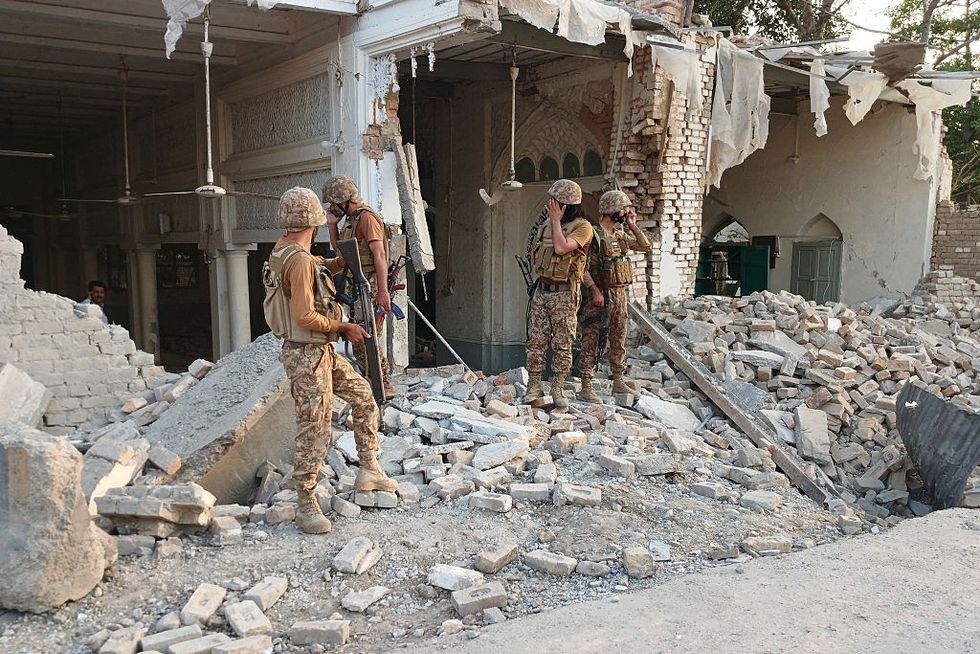 Army personnel stand amid the rubble following an explosion inside the police headquarters at Kohat in Pakistan's Khyber Pakhtunkhwa province on September 18, 2026. An explosion at a historic police headquarters in northern Pakistan on September 18 killed at least eight people and wounded 35 more, officials said, with the country's president swiftly blaming a militant group. Getty Images
 Mourners read the holy Quran while sitting around the grave of a paramilitary personnel of the Frontier Corps (FC) who was killed during the Afghanistan-Pakistan border clashes, in Kohat on October 17, 2025. A ceasefire along the frontier between Afghanistan and Pakistan was holding on October 16, officials on both sides said, after dozens of troops and civilians were killed in cross-border clashes.Getty Images