THE EXECUTIVE cannot become a judge, decide that an accused is guilty and punish him by demolishing his properties as such an act would be transgressing its limits, the Supreme Court said on Wednesday.
The apex court also observed it will be "totally unconstitutional" for more than one reason if a citizen's house is demolished merely because he is an accused or a convict, that too without following the due process as prescribed by law.
A bench of Justices B R Gavai and K V Viswanathan made these observations while delivering its judgement which laid down pan-India guidelines on demolition of properties.
It said the Executive cannot declare a person guilty, as this process is the fundamental aspect of the judicial review.
"Only on the basis of the accusations, if the executive demolishes the property/properties of such an accused person without following the due process of law, it would strike at the basic principle of rule of law and is not permissible," the bench said in its 95-page verdict.
"The executive cannot become a judge and decide that a person accused is guilty and, therefore, punish him by demolishing his residential/commercial property/properties. Such an act of the executive would be transgressing its limits," it said.
Abuse of power
The bench said the "chilling sight" of a bulldozer demolishing a building, when authorities have failed to follow the basic principles of natural justice and have acted without adhering to the principle of due process, reminds one of a lawless state of affairs, where "might was right".
It said the constitutional ethos and values would not permit any such abuse of power and such misadventures cannot be tolerated by the court of law.
The bench said such an action cannot be done in respect of a person who is convicted of an offence.
"Such an action by the executive would be wholly arbitrary and would amount to an abuse of process of law. The executive in such a case would be guilty of taking the law in his hand and giving a go-bye to the principle of the rule of law," it said.
The bench said if the Executive in an arbitrary manner demolishes the houses of citizens only on the ground that they are accused of a crime, then it acts contrary to the principles of 'rule of law'.
"If the executive acts as a judge and inflicts penalty of demolition on a citizen on the ground that he is an accused, it violates the principle of 'separation of powers'," it said.
"We are of the view that in such matters the public officials, who take the law in their hands, should be made accountable for such high-handed actions," the bench said.
The top court said when it is considering the issue with regard to 'rule of law' and 'separation of powers', it will also have to take into effect the matters where the Executive transgresses its power, acts as a judge and demolishes the structures of persons without following the procedure prescribed by law.
"Though the doctrine of public trust has been largely applied by this court in environmental matters, it cannot be disputed that the executive exercises its powers as a 'trustee' of the citizens. Therefore, the executive actions must be consistent with maintaining public trust," it said.
The bench said conversely, when the Executive acts in breach of the principles of 'rule of law' and 'separation of powers', the doctrine of public trust and accountability would come into play.
It noted that even in cases consisting of imposition of a death sentence, it is always a discretion available to the courts as to whether to award such an extreme punishment or not.
It said there is even an institutional safeguard in the cases of such punishment to the effect that the trial court's decision imposing death penalty cannot be executed unless it is confirmed by the high court.
Fair trial
The bench said even in the cases of convicts for the commission of most extreme and heinous offences, the punishment cannot be imposed without following the mandatory requirements under the statute.
"In that light, can it be said that a person who is only accused of committing some crime or even convicted can be inflicted the punishment of demolition of his property/properties? The answer is an emphatic 'No'," it said.
The top court said the principle that "an accused is not guilty unless proven so in a court of law" is foundational to any legal system.
It said this principle ensures that individuals are not unfairly punished or stigmatised based solely on accusations or suspicions.
The bench said the right to a fair trial is essential in upholding the rule of law and protecting individual liberties and it ensures that principles of natural justice and fair process are being strictly followed.
"It is thus required that the trial must be fair and open, but not prejudiced by public clamour. The precepts of natural justice are to ensure that the legal order will be impartially and regularly maintained," it said.
The top court delivered its verdict on pleas seeking framing of guidelines on demolition of properties in the country. (PTI)











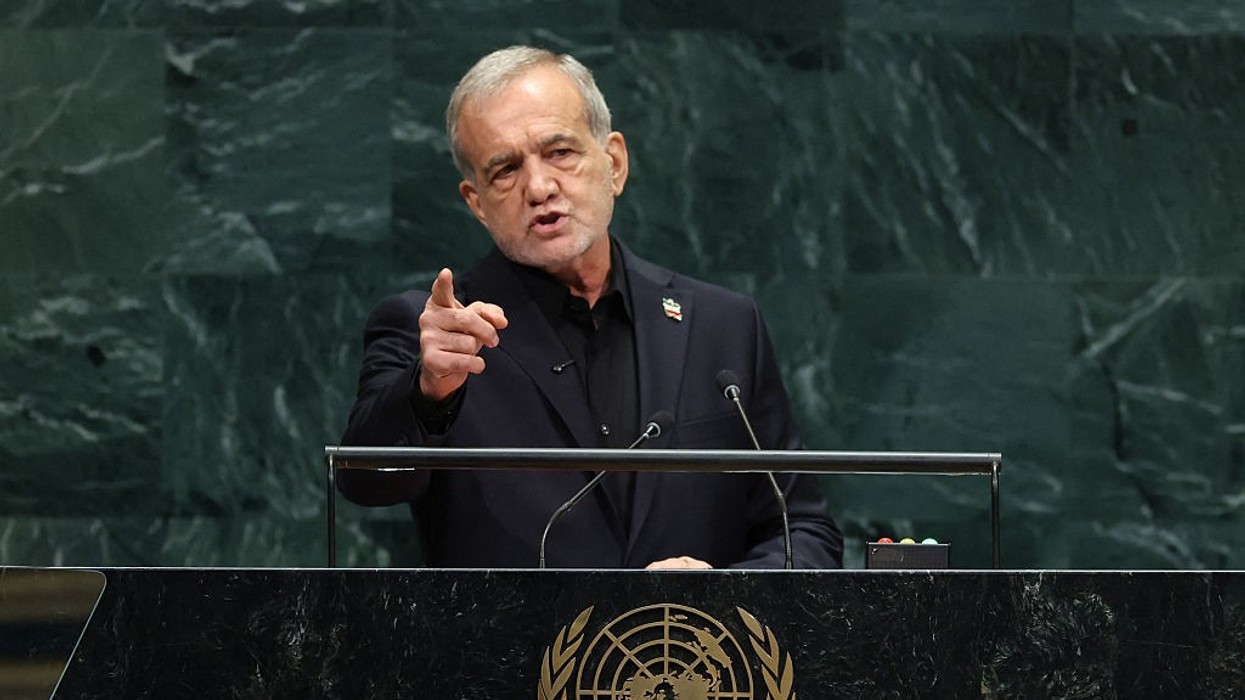
 President of Iran Masoud Pezeshkian holds up a poster of a girl's school that was attacked while addressing the 81st session of the United Nations (U.N.) General Assembly at U.N. Headquarters on September 23, 2026 in New York City. World leaders have gathered in New York for the annual session of the United Nations General Assembly, with this year's global issues ranging from the threat of artificial intelligence to the continued wars in Ukraine and Gaza. Getty Images