IN scathing remarks on web media’s accountability on Thursday (2), the Supreme Court of India has said that web portals “only listen to powerful voices” and “write anything” against judges or institutions. The apex court said this while hearing a case against media reports on the Tablighi Jamaat gathering in Delhi last year which was blamed for a spike in Covid cases in the early days of the pandemic.
The top court also said that news shown in a section of the media had a communal tone, adding that it could bring the country a bad name.
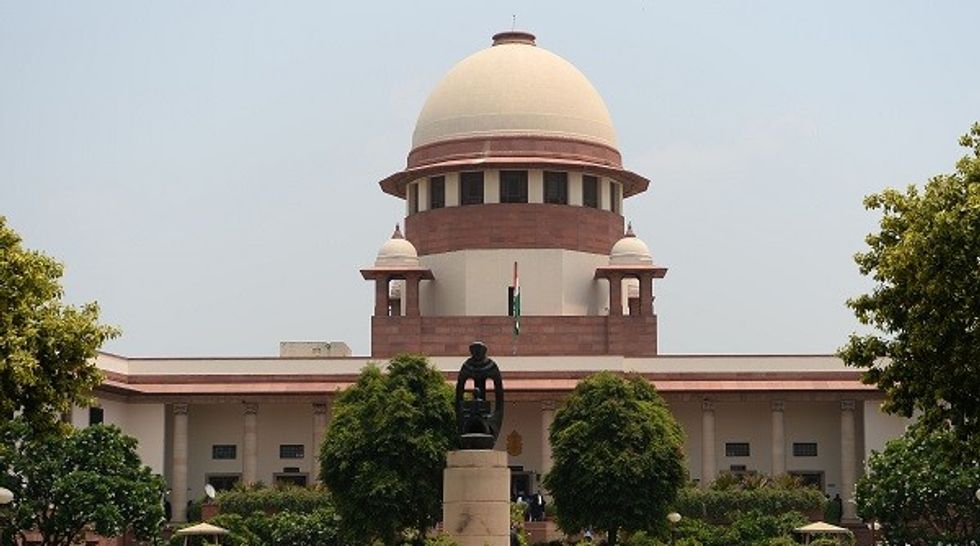 The Supreme Court of India (Photo: SAJJAD HUSSAIN/AFP/Getty Images).
Naming YouTube, Facebook and Twitter, the court said web portals have no accountability.
'The country is going to get bad name'
“The problem is, everything in this country is shown with a communal angle by a section of the media. That is the problem. The country is going to get a bad name ultimately,” Chief Justice of India (CJI) NV Ramana said while questioning the government about the regulatory mechanism for websites and TV channels.
“If you go to YouTube, you will find how fake news is freely circulated and anyone can start a channel on YouTube,” the Supreme Court bench comprising CJI Ramana and Justices Surya Kant and AS Bopanna said.
Solicitor general Tushar Mehta, who represented the government, said those sections of the media also planted stories and can even out fake news.
The Supreme Court is hearing a petition that requests action against media reports accused of “communal branding of Covid” linked to the Tablighi Jamaat gathering at Markaz Nizamuddin in the capital in mid-March last year.
“Web portals only listen to powerful voices and write anything against judges, institutions without any accountability. Web portal only worry about powerful men and not judges, institution or common people. That is our experience,” the top court added.
“Forget individuals. Web portals write very badly even against institutions,” the chief justice said.
Justice Ramana said he has not seen any web portal taking action. “At least the NBSA (National Broadcasting Standards Authority) are responding to responsible people. Respond to us,” he said.
The Jamiat Ulema-i-Hind, a body of Islamic scholars, has asked the top court to direct the Centre to stop dissemination of “fake news” related to the gathering at the Markaz Nizamuddin and take strict action against those responsible for it.
When the Supreme Court asked Mehta whether the government has attempted to regulate the private channels, he said the Narendra Modi government has come out with new Information and Technology Rules to take care of the issues flagged by the chief justice. He also added that many petitions are filed in high courts challenging the new information technology rules.
The Supreme Court agreed to hear after six weeks the Centre's plea seeking the transfer of petitions from various high courts on new IT rules meant to regulate online content.