THE Supreme Court of India on Thursday (15) called the British-era sedition law as “colonial” and questioned whether it was “still necessary after 75 years of independence”. The apex court said the law is a serious threat to the functioning of the institutions and holds “enormous power” for misuse with no accountability for the executive. It even compared the sedition law to a saw in the hands of an overzealous carpenter.
“The sedition law is a colonial law. Do we still need the law in our country after 75 years of Independence,” Chief Justice NV Ramana questioned. The top court also asked why the government, while taking a number of dated laws off the statute book, “is not looking into this law”.
Attorney General KK Venugopal in response suggested that the law be retained with “guidelines”.
ALSO READ: Facing court wrath, Centre asks states not to file cases under scrapped IT law
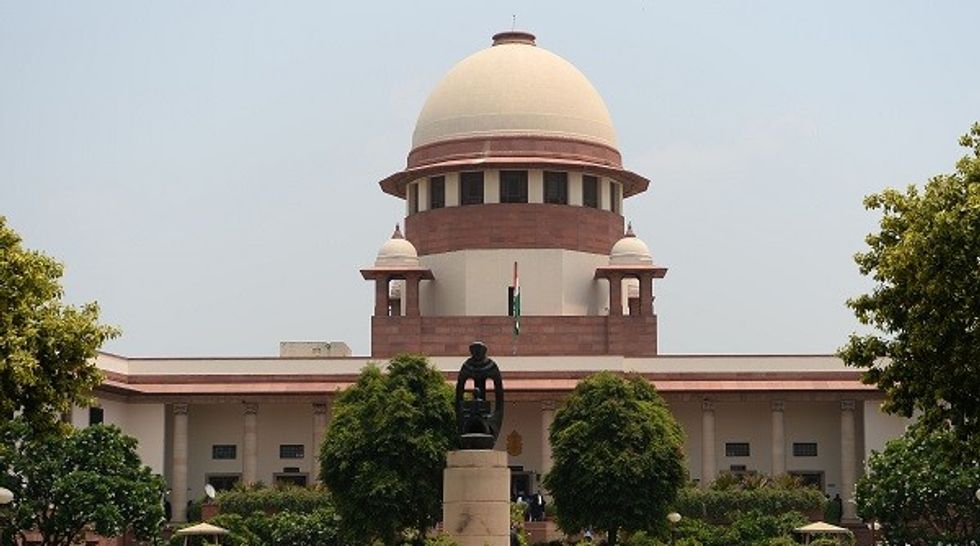 The Supreme Court of India (Photo: SAJJAD HUSSAIN/AFP/Getty Images).
A three-judge bench led by the chief justice compared Section 124A of the Indian Penal Code on sedition to “a saw” used to cut a forest instead of a piece of wood.
"Here is enormous misuse. The use of sedition is like giving a saw to the carpenter to cut a piece of wood and he uses it to cut the entire forest itself. That is the effect of this law,” the Supreme Court said.
Anti-terror law shouldn’t be misused to quell dissent: Supreme Court judge
“If a police officer wants to fix anybody in a village for something, he can use Section 124 A... People are scared,” it added.
The court said it would examine the validity of the sedition law and asked the Narendra Modi government to respond to a former army officer’s petition that says the law causes a “chilling effect” on speech and is unjustified restriction on free expression.
'The British used the same law to silence Mahatma Gandhi'
“The dispute is it is a colonial law... the very same law was used by the British to silence Mahatma Gandhi and to suppress the freedom movement. Is the law still necessary in the statute book in our country after 75 years of Independence?”
The court said a number petitions have challenged the sedition law and all will be heard together.
“Our concern is misuse of the law and no accountability of the executive,” the chief justice said.
Top court unimpressed with continued use of scrapped IT law
“We are not blaming any state or government, but look at how Section 66A of the Information Technology Act is continuing to be used, how many unfortunate people have suffered and there is no accountability for this...” he added.
The Centre on Wednesday (14) asked all states and Union Territories (UTs) to direct all police stations under their jurisdiction not to register cases under the repealed section of the Information Technology Act. The direction came from the ministry of home affairs little over a week after the Supreme Court called the continued use of Section 66A of the 2000 act as “a shocking state of affairs”.
The ministry also said that cases lodged in the states and UTs under the section should be immediately withdrawn.