
Highlights:
- Gunman entered hotel hosting major political event
- Suspect armed with multiple weapons
- Secret Service stopped attacker before ballroom
- Questions raised over perimeter security gaps
- Officials insist response prevented worse outcome
A gunman opening fire inside the hotel hosting the White House Correspondents' Association dinner on Saturday night (25) has triggered urgent questions about whether security gaps allowed him to get dangerously close to president Donald Trump and other senior officials. The incident, which unfolded at the Washington Hilton, forced the president and his cabinet to be rushed out as guests took cover, according to Reuters.
Authorities say the suspect, armed with a shotgun, handgun, and knives, charged a Secret Service checkpoint in the hotel lobby before being tackled and arrested. A Secret Service agent was injured, while the suspect was taken to the hospital for evaluation.
Yet even as officials praised the rapid response, attention has shifted to how the attacker managed to reach the hotel's interior at all during one of Washington's most tightly guarded annual events. Reports suggest that the answer may lie in a combination of access loopholes, a sprawling venue, and a security perimeter that may not have gone far enough.Law enforcement officials told Reuters that while the protective plan ultimately worked, stopping the gunman before he reached the ballroom, the fact that shots were heard inside the venue exposed vulnerabilities.
Unlike Trump’s campaign rallies, where outer security rings are often expansive, guests at the dinner reportedly needed only a ticket to enter the hotel itself. Metal detectors were placed closer to the ballroom rather than at the outermost access points.
"He didn't beat the security plan the night of the dinner. He beat it the day he made the reservation," Jason Pack, a former FBI official, told WSJ. "They built that perimeter to stop an army. Turns out all he needed was a room key." 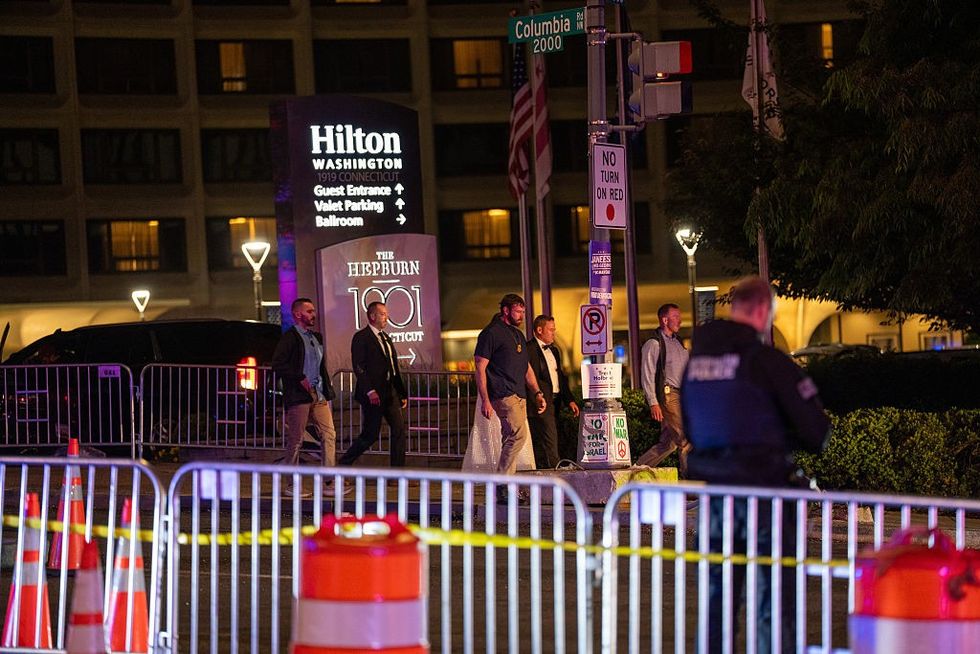 US Ambassador to the United Nations Mike Waltz is evacuated from the Washington Hilton Hotel where shots were fired near the White House Correspondents' Dinner featuring President Donald Trump in Washington, D.C. on April 25, 2026. Getty Images
More detailed accounts from The Wall Street Journal point to deeper structural issues. The suspect, identified as a 31-year-old man from California, had checked into the hotel days before the event, effectively bypassing external screening. "He didn't beat the security plan the night of the dinner. He beat it the day he made the reservation," a former FBI official told the publication.
Guests described relatively light verification checks at entry points, with tickets not always scanned and identification not consistently required. Once inside, individuals could access parts of the hotel without passing through security screening, encountering only magnetometers near the main event space.The attacker himself appeared to highlight these gaps in a manifesto, writing that he had expected "security cameras at every bend" but instead found minimal checks inside the hotel. Investigators are still tracing his exact movements from his room to the lobby, where he was eventually intercepted.
Despite the breach, officials have maintained that the layered defence system prevented a far worse outcome. Acting Attorney General Todd Blanche said, "The system worked. We stopped the suspect."A former US Secret Service agent says he believes the security service performed well in protecting president Trump on Saturday night (25).There were people present in the room, out of which some BBC reporters who gave their statements as eyewitnesses to the incident. One of them said, there was a “great response, great communication” from security agents, noting that the suspect was stopped at an “outer perimeter checkpoint.”
When asked about what appeared to be a pause before Trump exited the room, a BBC reporter described it as a "tactical pause.” "You don't want to be in such a hurry to rush out of one situation that you run into a worse situation."
He was also asked how someone could be inside the hotel with multiple guns while the president was present. The suspect was reportedly staying at the Washington Hilton.
The reporter also explained that authorities cannot simply "shut down business," emphasizing that the hotel was large and fully operational at the time.
"We can't go from room to room and search every room because the president is going to be there." His comments highlight the challenges security teams face when protecting a president in an active, public setting.
There was quote covered by BBC from correspondent Gary O'Donoghue, who described hearing a "low booming noise," while Washington correspondent Daniel Bush said there was "widespread confusion" as attendees took cover under tables.
(With inputs from Reuters and BBC)


 A visitor holds a baby at the Empty Sky 9/11 Memorial with One World Trade Center and Lower Manhattan in the distance on August 23, 2026 in Jersey City, New Jersey.Getty
 American flags and flowers line the memorial pool at the National September 11 Memorial to mark the 22nd anniversary of the 9/11 terror attack at the World Trade Center on September 11, 2023 in New York.Getty
 Balbir Singh Sodhi, a Sikh immigrant from India, was shot and killed outside the gas station he owned in Mesa, Arizona. .
 Muslim men pray during a Day of Remembrance open house at the Islamic Cultural Center of New York September 11, 2002 in New York City. Getty