
Highlights:
MARYLAND Public Service Commission chair Kumar Barve has spoken of his commitment to keeping electricity affordable for the state’s residents while explaining the challenges posed by data centers and extreme weather on consumer bills.
For Barve, the conversation about electricity bills in Maryland is not just about what appears at the bottom of a monthly statement. It is about everything behind that number: an aging grid, extreme weather, expensive infrastructure, renewable energy, growing demand from data centers and, ultimately, how much of that cost should be carried by the person sitting at home paying the bill.
“There are just dozens of things we have to do simultaneously in order to solve the problem,” he told India Weekly in an exclusive interview.
Barve, who was appointed chair of the Maryland Public Service Commission in January 2026, has spent much of his public life dealing with these questions. Before becoming a regulator, he served 32 years in the Maryland General Assembly, including as majority leader and chair of the Environment and Transportation Committee.
He was the first Indian American elected to a state legislature in the US.
“The governor wanted me to step up and take that role for that purpose,” Barve said, referring to his move to the commission. “To try to keep electricity more affordable.”
Barve’s explanation starts with something many customers may not immediately see on their bills. Utilities, he said, are not simply making money by selling electricity or natural gas. A large part of the cost comes from establishing the infrastructure needed to get electricity to homes and businesses.
“The way utilities make their money is by building the infrastructure that delivers the electrons to your wall socket. And that has become more expensive over the years,” he said.
In Maryland and across the Northeast, more extreme weather has meant more spending to make the electric grid stronger and more reliable. At the same time, the price of steel, concrete and other materials used for substations, transmission lines and poles has also increased.
The costs do not disappear after the work is completed. Utilities can spread those infrastructure costs, along with interest, over long periods.
Barve compared it to taking a loan against a home to renovate the kitchen or repair the roof. The work may have been completed years earlier, but the cost continues to appear in the monthly payment. “That cost is going to be living with us for another 20 years,” he said.
His background as an accountant gives him a sharp focus on reducing costs for ratepayers while Maryland continues its transition toward cleaner energy.
The challenge, he said, is finding ways to expand renewable energy without making the transition unnecessarily expensive. The commission’s recent decisions show how closely affordability has become tied to rate cases.
In August, the Maryland Public Service Commission (PSC) authorized less than half of Potomac Electric Power Company’s (Pepco) requested revenue increase, resulting in a smaller estimated monthly impact for residential customers.
The next pressure point is newer. Maryland, like other parts of the country, is seeing growing electricity demand from data centers and artificial intelligence infrastructure. For ordinary residents, the concern is simple: if demand rises sharply, will households end up paying for the new infrastructure?
Barve says they should not. “In America, we charge industrial users of electricity more than we charge residential ratepayers,” he said, noting that large users can pay higher rates.
His position is that data centers should bear the cost of the additional resources their operations require.
“The consensus in Maryland and the consensus in America is to have these data centers pay 100 per cent for the resources and demands that they make.”
He also pointed out that not every part of a data center’s workload operates in exactly the same way. Banking and other commercial functions may need to operate continuously, while some artificial intelligence functions can be paused during periods of grid stress. The larger question, however, is how Maryland builds enough power without passing every new expense on to households.
Barve does not see one technology as the complete answer. Solar can make an important near-term contribution, but he argues that nuclear power, batteries, transmission and offshore wind all have roles to play.
It is a very different position from the one Barve occupied when he first entered public life.
In 1990, Indian Americans were still relatively new to American electoral politics. Barve remembers having difficulty getting some members of the community to believe that an Indian American candidate could win. He did, becoming the first person of Indian origin elected to a US state legislature. He eventually served 32 years in the Maryland General Assembly.
His own family story stretches much further back.
His maternal grandfather left India for Scotland and eventually reached Schenectady, New York, in 1911, where he worked as a research scientist for General Electric. It took him years to bring his family from India to the United States. Barve’s father was born in Tarapore, north of Mumbai, and later moved to Britain before eventually coming to the United States. Barve himself was born in Schenectady in 1958.
For Barve, India was never completely distant. He has visited several times and recalls spending five months in India in 1981, living with family, as one of his favorite experiences there. He also traveled to Kolkata after Mother Teresa’s death as part of a delegation representing the Indian American community.
Yet he describes his childhood as distinctly American. Barve says he was “more of a math person.”
That combination perhaps explains some of the ease with which he moves between the two parts of his story: his Indian family history and the very American question of how much a household should have to pay to keep its lights on.
Today, when he looks at Maryland’s energy future, the answer is still complicated. More solar, offshore wind, batteries, transmission and nuclear power, he says, will all be needed. And when utilities ask customers to pay for major investments, the commission has to examine whether those costs are actually necessary.
“We have to make sure they haven’t overspent,” Barve said.
For a regulator, that may sound like a technical principle. For the family opening an electricity bill every month, it is much more direct: how much of the future should they have to pay for today?





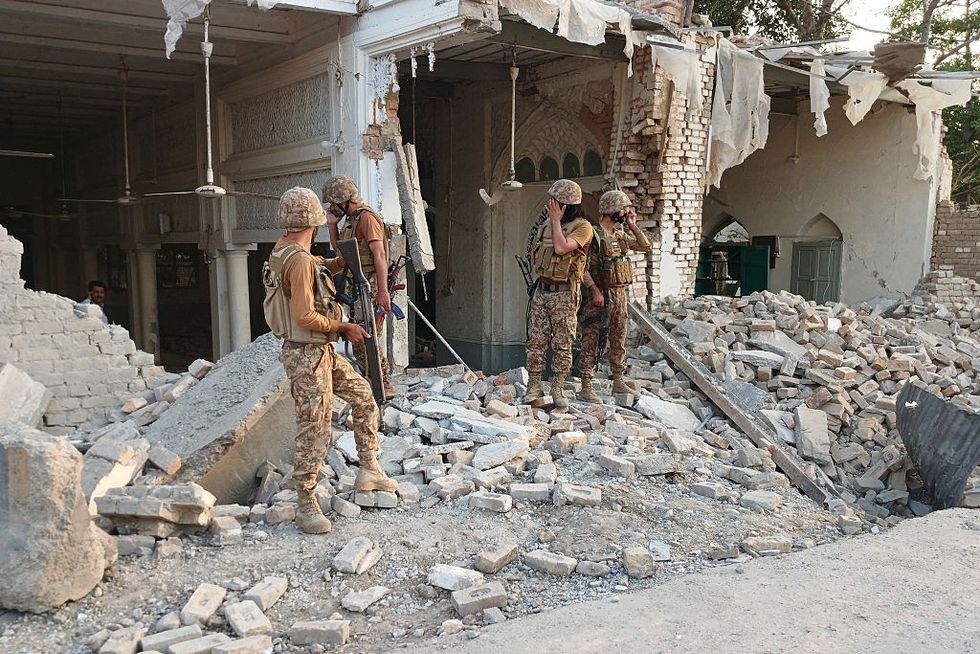 Army personnel stand amid the rubble following an explosion inside the police headquarters at Kohat in Pakistan's Khyber Pakhtunkhwa province on September 18, 2026. An explosion at a historic police headquarters in northern Pakistan on September 18 killed at least eight people and wounded 35 more, officials said, with the country's president swiftly blaming a militant group. Getty Images
 Mourners read the holy Quran while sitting around the grave of a paramilitary personnel of the Frontier Corps (FC) who was killed during the Afghanistan-Pakistan border clashes, in Kohat on October 17, 2025. A ceasefire along the frontier between Afghanistan and Pakistan was holding on October 16, officials on both sides said, after dozens of troops and civilians were killed in cross-border clashes.Getty Images