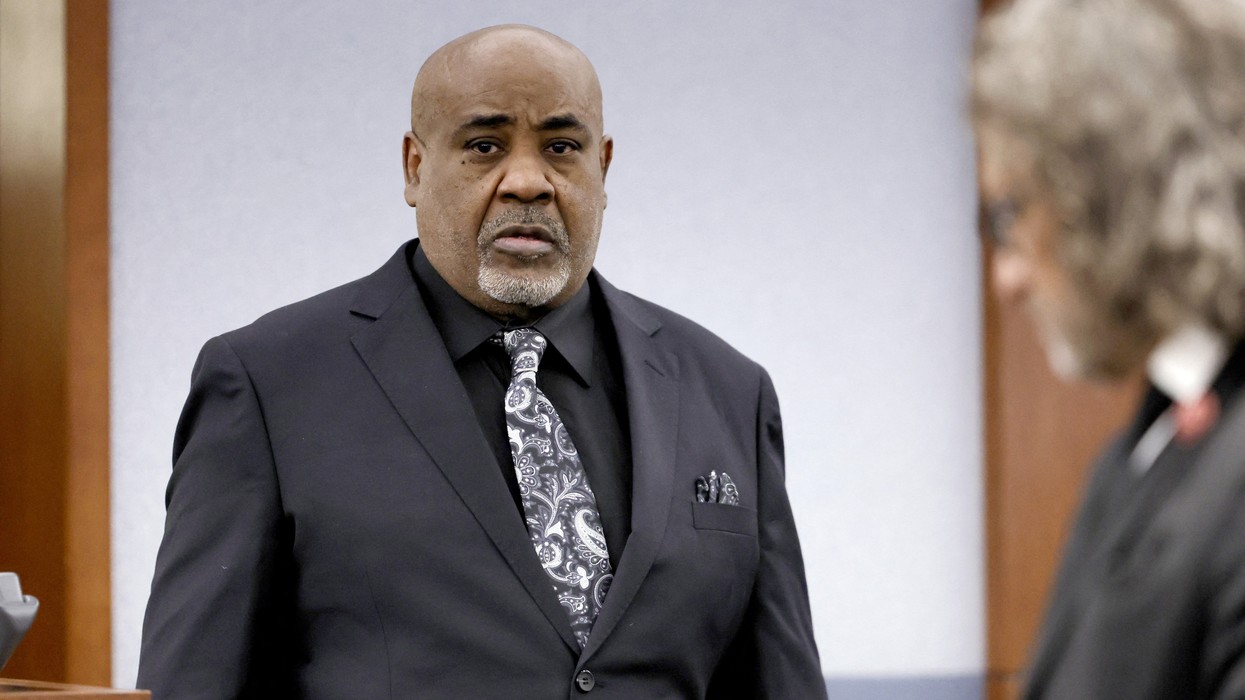

For almost three decades, the murder of Tupac Shakur was one of America's most notorious unsolved cases. This week it finally ended in a conviction which was built not on a weapon, a getaway car or CCTV footage, but on the words of the man in the dock.
Duane "Keffe D" Davis, 63, a former leader of the South Side Compton Crips, has been found guilty of murder with a deadly weapon over the fatal drive-by shooting of the rapper in Las Vegas on September 7, 1996. He is due to be sentenced on October 13, and has already said he will appeal.
The strange courtroom argument at the heart of the case
What made the trial unusual was not the evidence itself, but who was arguing what. Prosecutors spent weeks trying to convince the jury that a self-confessed career criminal was telling the truth. Davis's own defense team argued the opposite: that their client was a liar who had invented a story to sell books and podcasts.
The reason for this role reversal is simple: Davis had no forensic evidence tying him to the crime. What he had was years of his own public statements — to police, in a memoir, on a true-crime documentary and in podcast interviews — describing his role in the killing in detail. Prosecutors leaned entirely on those accounts. "Almost all of the evidence the state will seek to introduce" was aimed at establishing that Davis's various versions of events were credible, they said in a pre-trial filing.
Davis's account first surfaced in 2008, when he spoke to a federal task force investigating the unrelated murder of Notorious B.I.G. under a "proffer" agreement — an arrangement that normally shields a suspect's statements from being used against them later. In that interview, Davis said he was in the front seat of the Cadillac when his nephew, Orlando Anderson, who was in the back, fired the fatal shots. Anderson always denied involvement and died in an unrelated shooting in 2008.
That proffer agreement should have protected Davis. Instead, he went on to describe the same events publicly and repeatedly — in a 2018 BET documentary interview, and then in far greater detail in his 2019 memoir, Compton Street Legend. Courts ruled that by choosing to publish and give interviews, Davis had voided his own protection, opening the door for prosecutors to use both his book and his original 2008 police interview against him at trial.
To bolster Davis's credibility with the jury, prosecutors pointed to details in the book that lined up with independent evidence — including his description of the suit he was wearing that night, which matched a Polaroid photograph investigators later found. Their own filing conceded the book was "salacious" and contained inaccuracies and at least one substantial lie, but argued it was broadly consistent with the facts of Davis's life and that night.
The defense took the opposite approach, seizing on the book's exaggerations and inconsistencies to argue the whole account was unreliable. In closing arguments, defense lawyer Michael Sanft urged jurors to see his client as a man who had told tall tales purely to make money, telling them plainly: "There's no proof." Prosecutor Binu Palal countered by asking the jury to take Davis at his word, arguing that in "every instance, in every iteration," Davis had positioned himself as the leader who gave the order. The jury took only hours to convict.
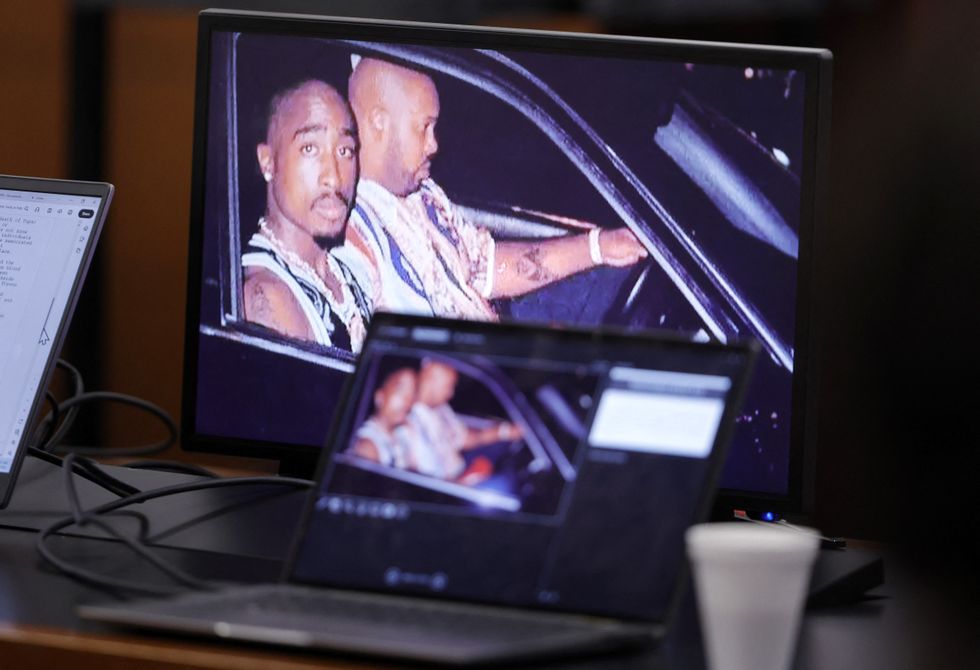 A 1996 photo of rapper Tupac Shakur (L) and Marion "Suge" Knight is shown on screens during closing arguments in the Duane Davis murder trial, related to the 1996 killing of rapper Tupac Shakur, at Clark County District Court at the Regional Justice Center in Las Vegas, Nevada, on August 31, 2026. Getty Images
What the book says happened that night
Compton Street Legend opens in Las Vegas on the night of September 7, 1996, with Davis describing a plan to confront Shakur and Knight in retaliation for an earlier fight involving his nephew. He wrote that he obtained a Glock pistol and got into a white Cadillac with three other men, driving around the Strip in search of the pair.
When they spotted Shakur's car, Davis wrote: “No words exchanged, the time for talking had passed, the sh*t was about to go down!”. Tupac's death, the book suggests, was the inevitable result of breaking the unwritten "code of the street" — the memoir even describes the killing as, in Davis's telling, understandable within that code. Elsewhere in the book, Davis wrote about building a multimillion-dollar drug operation, material prosecutors also used to paint a picture of a man used to being in charge, not a passenger to events.
Since his arrest, Davis has tried to walk all of this back, claiming his book, documentary appearances and police statements were false, and blaming a co-author for inserting inaccurate material. The jury did not accept that explanation.
The legacy that outlasted the case
Whatever the courtroom argued about Davis's credibility, there has never been any dispute about Shakur's impact. Born in New York in 1971 to Black Panther Party parents, Tupac Shakur became one of the most influential musical artists of the 20th century and a prominent voice on social injustice and the marginalization of Black America, even as his career became inseparable from gangsta rap and the violent East Coast–West Coast rivalry that likely led to his death. He has sold more than 75 million records worldwide, and albums released after his murder — including The Don Killuminati: The 7 Day Theory — went on to multi-platinum success. He was inducted into the Rock and Roll Hall of Fame in 2017 and received a posthumous star on the Hollywood Walk of Fame in 2023. Nearly 30 years on, a conviction has finally been secured — but Shakur's cultural footprint was never really in question.