HENRY Kissinger, the veteran American diplomat who died at the age of 100 on Wednesday (29), was known for his disdain towards India's leadership in the 1970s and even had used racist and misogynist language for the then prime minister Indira Gandhi.
When the centurion died in his Connecticut home, he left behind a chequered legacy.
From his first visit to India in October 1974 to the one in March 2012, Kissinger, termed as a statesman by many, had reconciled to India's rise and as many believed, had become a votary of stronger US-India ties.
Read: When ping pong diplomacy paved way for Kissinger's historic China visit
Kissinger's ties with India started in the 1970s when he was in the US administration both as the national security adviser (NSA) and secretary of state. In September 2020, the New York Times carried an opinion piece based on the then newly declassified trove of White House tapes that provided "startling evidence of the bigotry” voiced by then president Richard Nixon and Kissinger, his NSA in the 1970s.
'They are masters at subtle flattery'
Replying to a question by Nixon, the piece described how Kissinger sweepingly explained: “They (Indians) are superb flatterers, Mr. President. They are masters at flattery. They are masters at subtle flattery. That's how they survived 600 years. They suck up — their great skill is to suck up to people in key positions.”
Read: Kissinger disliked Indira Gandhi but batted for robust ties with Modi's India
Detailing such insidious exchanges between the Nixon-Kissinger duo based on the declassified tapes, Gary J. Bass, a professor of politics and international affairs, explained how the full content of these tapes revealed how "US policy toward South Asia under Mr. Nixon was influenced by his hatred of, and sexual repulsion toward, Indians."
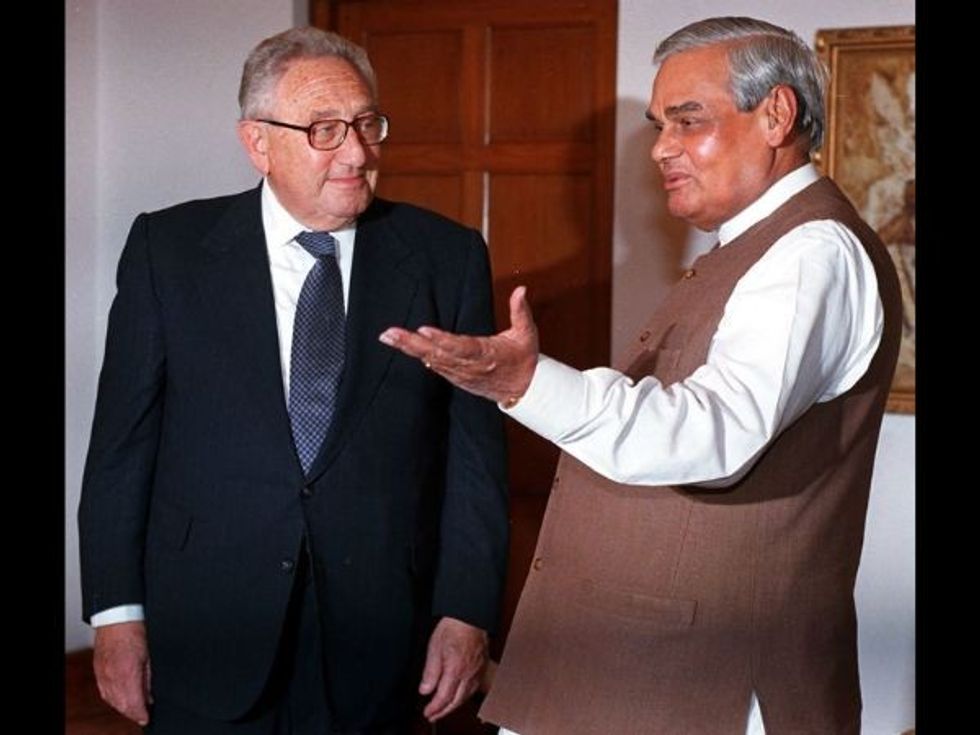 Former Indian prime minister Atal Behari Vajpayee (R) talks with former US secretary of state Henry Kissinger in New Delhi in June 1999. (Photo by TEKEE TANWAR/AFP via Getty Images)
"For decades, Mr. Nixon and Mr. Kissinger have portrayed themselves as brilliant practitioners of realpolitik, running a foreign policy that dispassionately served the interests of the United States. But these declassified White House tapes confirm a starkly different picture: racism and misogyny at the highest levels, covered up for decades under ludicrous claims of national security. A fair historical assessment of Mr. Nixon and Mr. Kissinger must include the full truth, unbleeped,” Bass concluded.
Kissinger, Nixon repeatedly called Indira Gandhi a b**ch
The transcripts of the declassified tapes of the conversation between Nixon, Kissinger, and the president's Chief of Staff in Washington on November 5, 1971, showed that both Nixon and Kissinger repeatedly described Indira Gandhi as a b**ch. "(But), Mr. President, even though she was a b**ch, we shouldn't overlook the fact that we got what we wanted, which was we kept her from going out of here saying that the United States kicked her in the teeth,” Kissinger said in connection with their discussion regarding Pakistan, India, and troubles in East Pakistan, now Bangladesh.
Speaking about the issue in India in March 2012 at a media conclave, Kissinger defended his use of unparliamentary language while referring to former prime minister Indira Gandhi, said: “I was under pressure and made those comments in the heat of the moment. People took those remarks out of context." He also added that he had the highest regard for Indira Gandhi, it was reported then.
Historians indeed say that both Kissinger and Nixon did not have a healthy relationship with Indira Gandhi and they turned their attention to China.
But before that, his first preference was India as was evident from the establishment of US India Business Council (USIBC) in the 1970s on his advice to the US Chambers of Commerce. However, despite the not-so-healthy relationship with the then-Indian leadership, as early as 1972, Kissinger had advocated for India and Japan to be permanent members of the UN Security Council, archival diplomatic conversations available publicly show.
Speaking at another US-India Strategic Partnership Forum (USISPF) event, Kissinger, then 96, said the Bangladesh crisis pushed the two countries to the "edge of confrontations".
“India was at the beginning of a historic evolution and not all of the problems that concerned were of equal importance to India. India was heavily involved with its own evolution and the policy of neutrality," he then said in New Delhi.
"If you look at the world, there are upheavals in almost every part of the world and you cannot necessarily develop a general concept for each of them but you can work together on the essentials of peace and progress. Then I would say no two countries now are better situated to evolve their friendship," Kissinger said.
A day after Dhaka was liberated on December 16, 1971, Nixon was told by Kissinger that he had "saved West Pakistan," according to confidential papers since declassified by the US state department.
Kissinger told then-president Gerald Ford after his meeting with Indira Gandhi in October 1974, a few months after India's first nuclear test, that she had felt an “almost pathological need” to criticise the US but at the same time desired an improvement in India-US relations on a “more equal” basis after Washington recognised India as an “important country in the world”.
“Our relations with India are friendly and aloof. It's a fortunate thing the Indians are pacifists, otherwise, their neighbours would be worried. The first time we were in India, they told me that Kabul belonged to India too," Kissinger has been recorded as having said, according to a White House Memo.
Kissinger's views on India changed after its rise
After the end of the Cold War, and the emergence of India as a strong power in the last decade, his views on India had changed and for successive administrations, Kissinger has been advocating strong ties with India.
Prime minister Narendra Modi has had a few meetings with him during his trips to the United States. When Modi was here on an Official State Visit in June this year, Kissinger, despite not keeping good health, travelled to Washington to listen to Modi's address at the luncheon at the state department jointly hosted by vice president Kamala Harris and secretary of state Antony Blinken.
Kissinger was brought in a wheelchair to the historic Benjamin Franklin Room on the seventh floor of the Foggy Bottom headquarters of the state department. During the luncheon, the elderly American statesman patiently listened to the speech of the prime minister and had an interaction with him.
In recent years, Kissinger made his views known to the public on India when he made a fireside appearance in June 2018 along with John Chambers of the US India Strategic and Partnership Forum on the occasion of the organisation's first anniversary.
The fireside chat was closed to the press, but those who attended it recollect how strongly he batted for the India-US relationship. "When I think about India, I admire their strategy," Kissinger had said during a rare appearance in Washington to attend the first annual leadership summit of the USISPF in June 2018.
(With PTI inputs)